- These notes were prepared while studying for technical interviews (e.g., Snap Inc., Krafton, etc.).
- Each entry contains a concise English summary, key math expressions, and excerpts from my original handwritten/typed study notes.
These notes cover the evolution from recurrent to attention-based sequence models, the mechanics of self-attention, the variants used to control its cost, and the adaptation of Transformers to images via patch tokens.
RNN
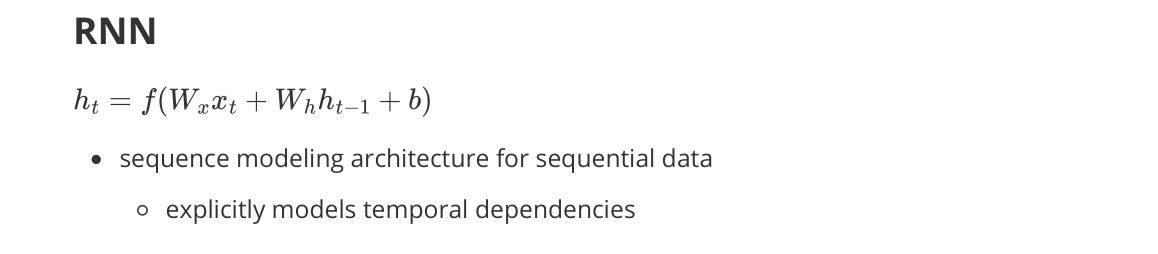
- sequence modeling architecture for sequential data
- explicitly models temporal dependencies
- processes inputs step by step in time order
- hidden state carries information across time steps
- same weights shared across time
- order-sensitive & variable-length input handling
- hidden state acts as a compressed summary of the past
Backpropagation Through Time (BPTT)
- unfold the RNN over time → apply backpropagation across time steps
- prone to vanishing or exploding gradients
- gradients flow backward through many steps
Limitations
- Vanishing gradients
- long-range dependencies are hard to learn
- Sequential computation
- no parallelism across time steps
- long-context modeling is inefficient
LSTM / GRU

- introduce gating mechanisms → mitigate vanishing gradient problem
- still sequential → scalability issues remain
RNN vs Transformer
- RNN
- strong inductive bias for sequence order
- sequential, memory-based
- Transformer
- attention-based global context
- fully parallelizable
- better long-range dependency modeling
Transformer

- sequence-to-sequence architecture based on attention
- parallel computation over sequence positions
Encoder
- input sequence → encoding (mapping) → contextualized representations (context-aware embeddings)
- Self-attention
- each token attends to all other tokens in the input sequence
- from the same sequence
- captures global context within representations
- each token attends to all other tokens in the input sequence
Decoder
- generate the output sequence autoregressively
- Masked self-attention
- prevent attending to future tokens
- previously generated tokens from the decoder
- causal mask → preventing future information leakage
- Cross-attention
- give attention over encoder outputs
- allowing the decoder to condition on the input
- query: decoder
- key, value: encoder
- give attention over encoder outputs
Scaled Dot-Product Attention
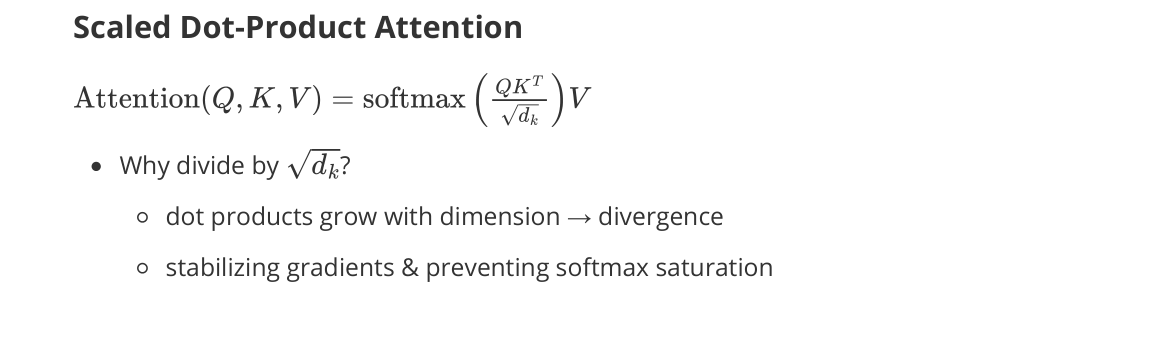
Why divide by $\sqrt{d_k}$?
- dot products grow with dimension → divergence
- stabilizing gradients and preventing softmax saturation
Multi-Head Attention
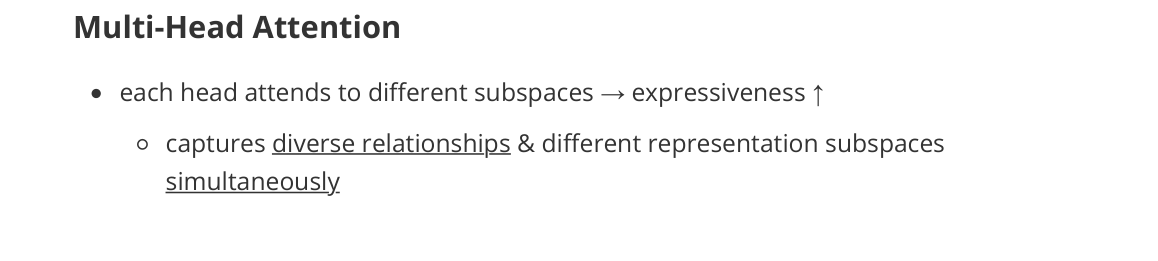
- each head attends to different subspaces → expressiveness ↑
- captures diverse relationships and different representation subspaces simultaneously
Attention Complexity
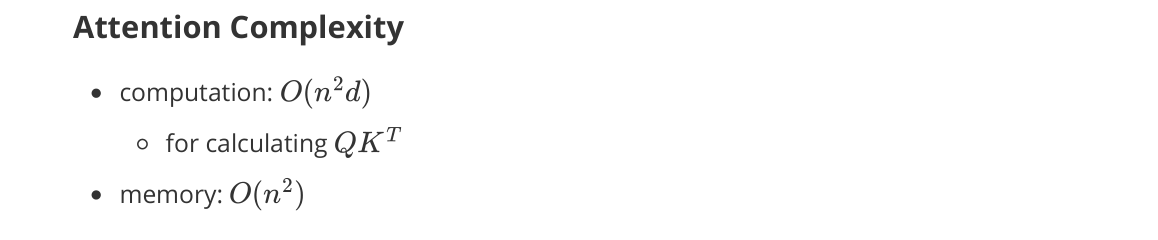
- computation: $O(n^2 d)$
- for calculating $QK^\top$
- memory: $O(n^2)$ for the attention weights matrix
Long-Context Attention Variants
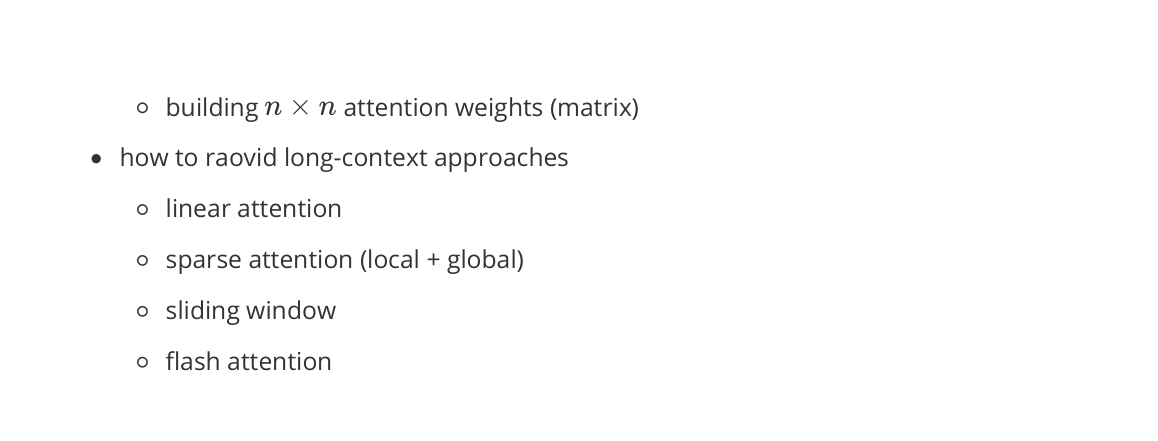
Linear Attention
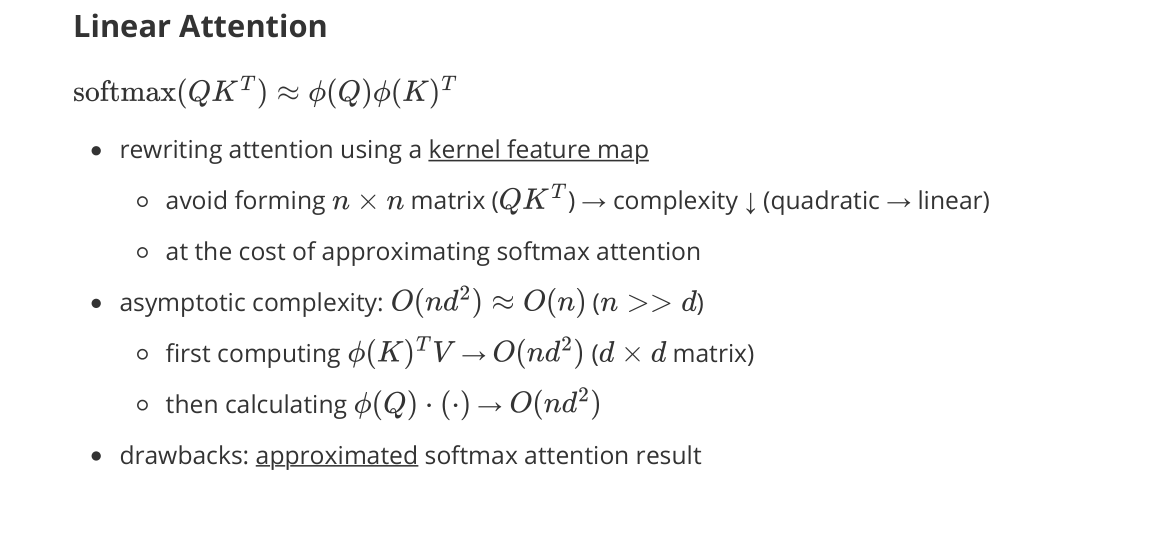
- rewriting attention using a kernel feature map $\phi$
- avoid forming $n \times n$ matrix $(QK^\top)$ → complexity ↓ (quadratic → linear)
- at the cost of approximating softmax attention
- asymptotic complexity: $O(n d^2) \approx O(n)$ (when $n \gg d$)
- first computing $\phi(K)^\top V \to O(n d^2)$ ($d \times d$ matrix)
- then calculating $\phi(Q) \cdot (\cdot) \to O(n d^2)$
- drawbacks: approximated softmax attention result
Sliding Window Attention
- each token attends only to a local window of neighboring tokens
- limiting receptive field → reducing quadratic attention cost
- pros: preserves local context well
- cons
- cannot directly capture long-range dependencies
- global information may be lost
Sparse / Flash Attention
- sparse attention (local + global mixtures)
- flash attention: I/O-aware exact attention with tiled computation
Positional Encoding
- Transformers are permutation-invariant (no notion of order) → inject positional information
- added to token embeddings as an additive bias
Sinusoidal Positional Encoding
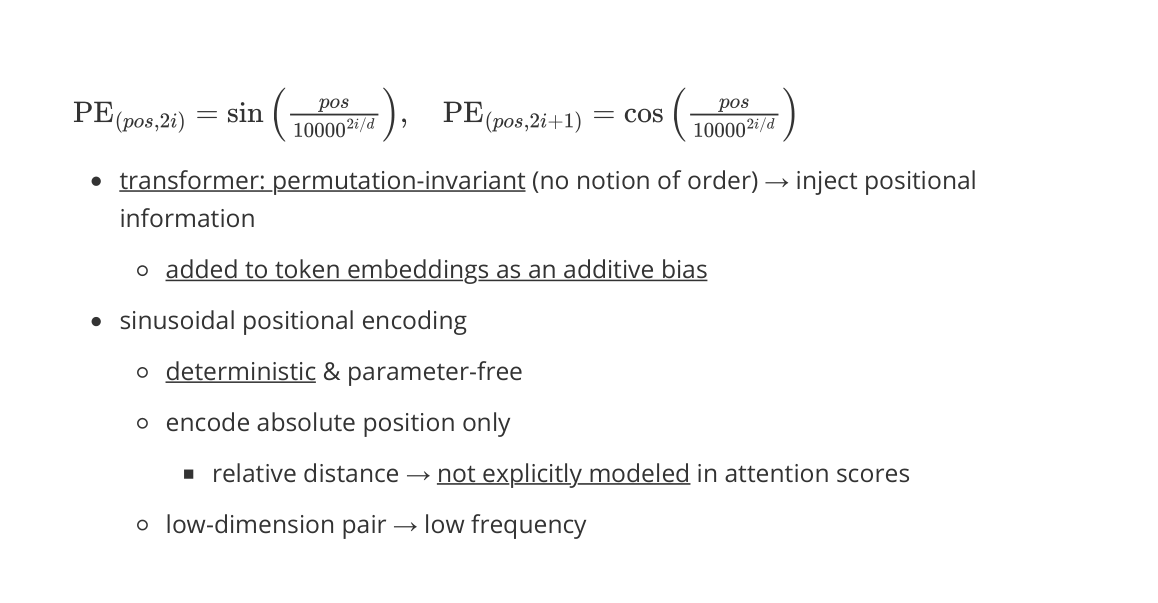
- deterministic & parameter-free
- encodes absolute position only
- relative distance → not explicitly modeled in attention scores
- low-dimension pair → low frequency
Rotary Positional Encoding (RoPE)
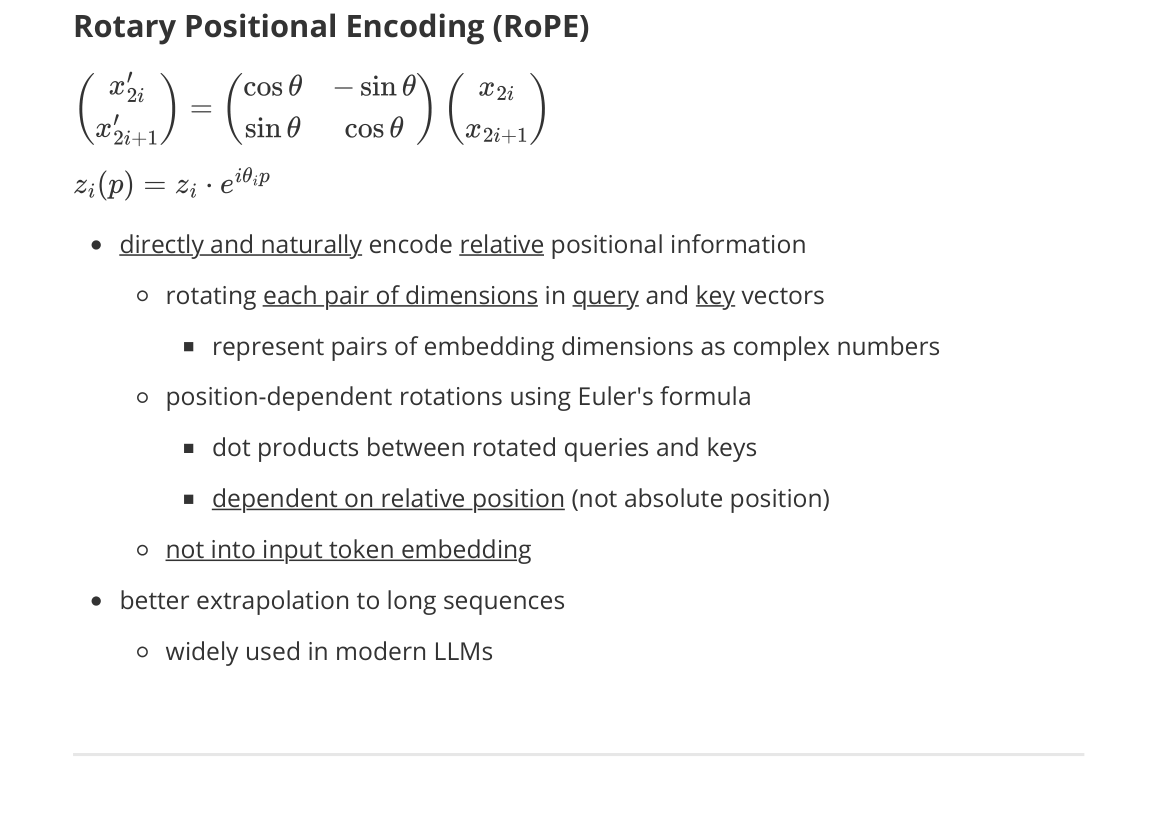
- directly and naturally encodes relative positional information
- rotates each pair of dimensions in query and key vectors
- represents pairs of embedding dimensions as complex numbers
- position-dependent rotations using Euler’s formula
- dot products between rotated queries and keys
- dependent on relative position (not absolute position)
- not added to input token embeddings
- rotates each pair of dimensions in query and key vectors
- better extrapolation to long sequences
- widely used in modern LLMs
Vision Transformer (ViT)

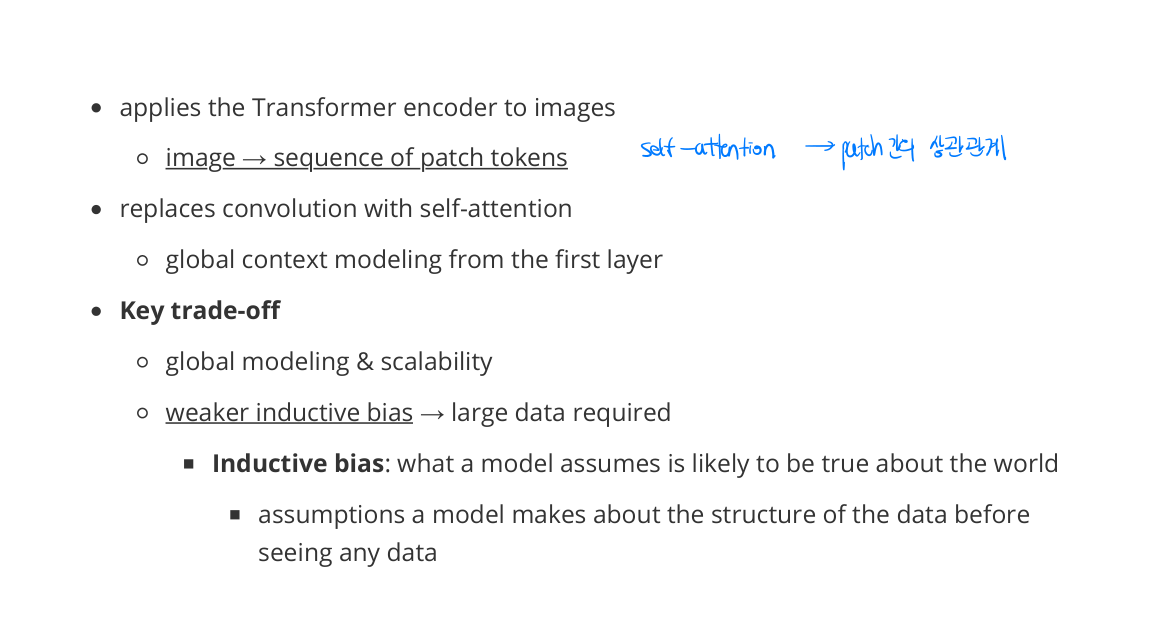
- applies the Transformer encoder to images
- image → sequence of patch tokens
- replaces convolution with self-attention
- global context modeling from the first layer
Key trade-off
- global modeling & scalability
- weaker inductive bias → large data required
- Inductive bias: what a model assumes is likely to be true about the world
- assumptions a model makes about the structure of the data before seeing any data
- Inductive bias: what a model assumes is likely to be true about the world
Patch Embedding

- split image into fixed-size patches
- flatten + linear projection → tokens
Positional Encoding

- inject spatial information into patch embeddings
- required due to permutation-invariant attention
[CLS] Token
![[CLS] Token](/images/archives/notes/09-sequence-models-p43-cls-token.png)
- prepend a learnable classification token to the patch sequence
- participates in self-attention with all patches
- aggregates global image information across layers
- final classification head applied to the [CLS] representation