- These notes were prepared while studying for technical interviews (e.g., Snap Inc., KRAFTON, etc.).
- Each entry contains a concise English summary, key math expressions, and excerpts from my original handwritten/typed study notes.
These notes cover the family of neural 3D scene representations: from MLP-based radiance fields to hash-grid accelerations and the explicit Gaussian-based formulation that enables real-time rendering.
Neural Radiance Field (NeRF)

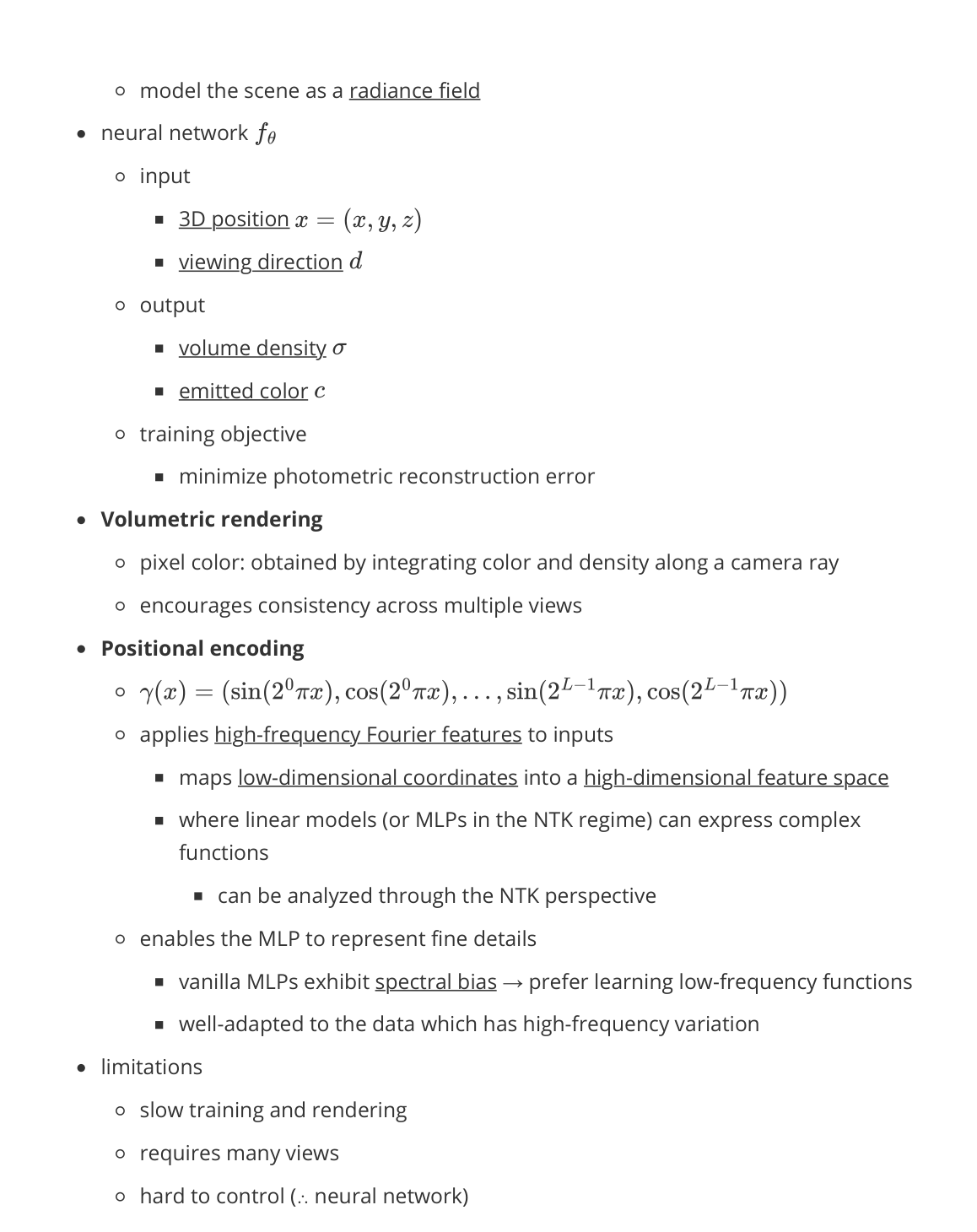
- continuous neural representation of a 3D scene
- represents a scene as a function parameterized by a neural network
- model the scene as a radiance field
- represents a scene as a function parameterized by a neural network
- neural network $f_\theta$
- input
- 3D position $x = (x, y, z)$
- viewing direction $d$
- output
- volume density $\sigma$
- emitted color $c$
- training objective
- minimize photometric reconstruction error
- input
- Volumetric rendering
- pixel color: obtained by integrating color and density along a camera ray
- encourages consistency across multiple views
- Positional encoding
- $\gamma(x) = (\sin(2^0 \pi x), \cos(2^0 \pi x), \ldots, \sin(2^{L-1} \pi x), \cos(2^{L-1} \pi x))$
- applies high-frequency Fourier features to inputs
- maps low-dimensional coordinates into a high-dimensional feature space
- where linear models (or MLPs in the NTK regime) can express complex functions
- can be analyzed through the NTK perspective
- enables the MLP to represent fine details
- vanilla MLPs exhibit spectral bias → prefer learning low-frequency functions
- well-adapted to data which has high-frequency variation
- limitations
- slow training and rendering
- requires many views
- hard to control (∵ neural network)
Neural Tangent Kernel (NTK)
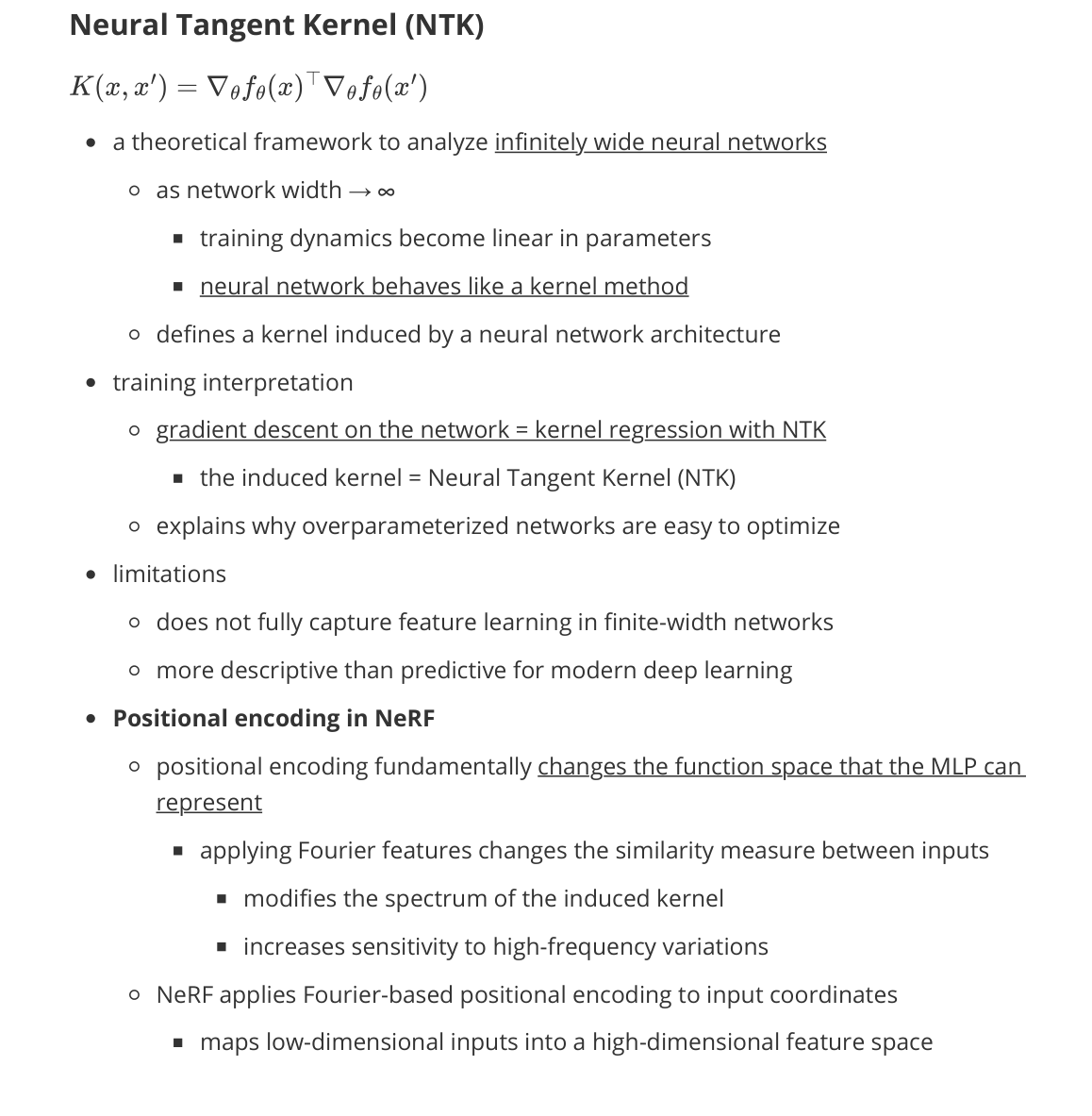
- a theoretical framework to analyze infinitely wide neural networks
- as network width → ∞
- training dynamics become linear in parameters
- neural network behaves like a kernel method
- defines a kernel induced by a neural network architecture
- as network width → ∞
- training interpretation
- gradient descent on the network = kernel regression with NTK
- the induced kernel = Neural Tangent Kernel (NTK)
- explains why overparameterized networks are easy to optimize
- gradient descent on the network = kernel regression with NTK
- limitations
- does not fully capture feature learning in finite-width networks
- more descriptive than predictive for modern deep learning
- Positional encoding in NeRF
- positional encoding fundamentally changes the function space that the MLP can represent
- applying Fourier features changes the similarity measure between inputs
- modifies the spectrum of the induced kernel
- increases sensitivity to high-frequency variations
- applying Fourier features changes the similarity measure between inputs
- NeRF applies Fourier-based positional encoding to input coordinates
- maps low-dimensional inputs into a high-dimensional feature space
- positional encoding fundamentally changes the function space that the MLP can represent
InstantNGP

- accelerate neural field training and rendering (NeRF-style)
- represent coordinates with a multi-resolution hash grid instead of high-dim sinusoidal encoding
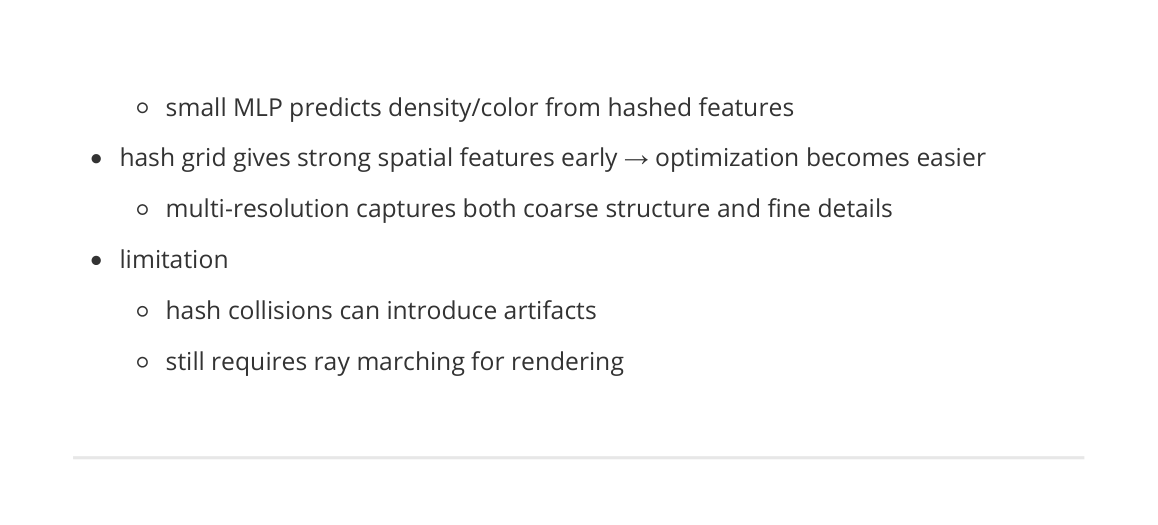
- small MLP predicts density / color from hashed features
- hash grid gives strong spatial features early → optimization becomes easier
- multi-resolution captures both coarse structure and fine details
- limitation
- hash collisions can introduce artifacts
- still requires ray marching for rendering
Gaussian Splatting
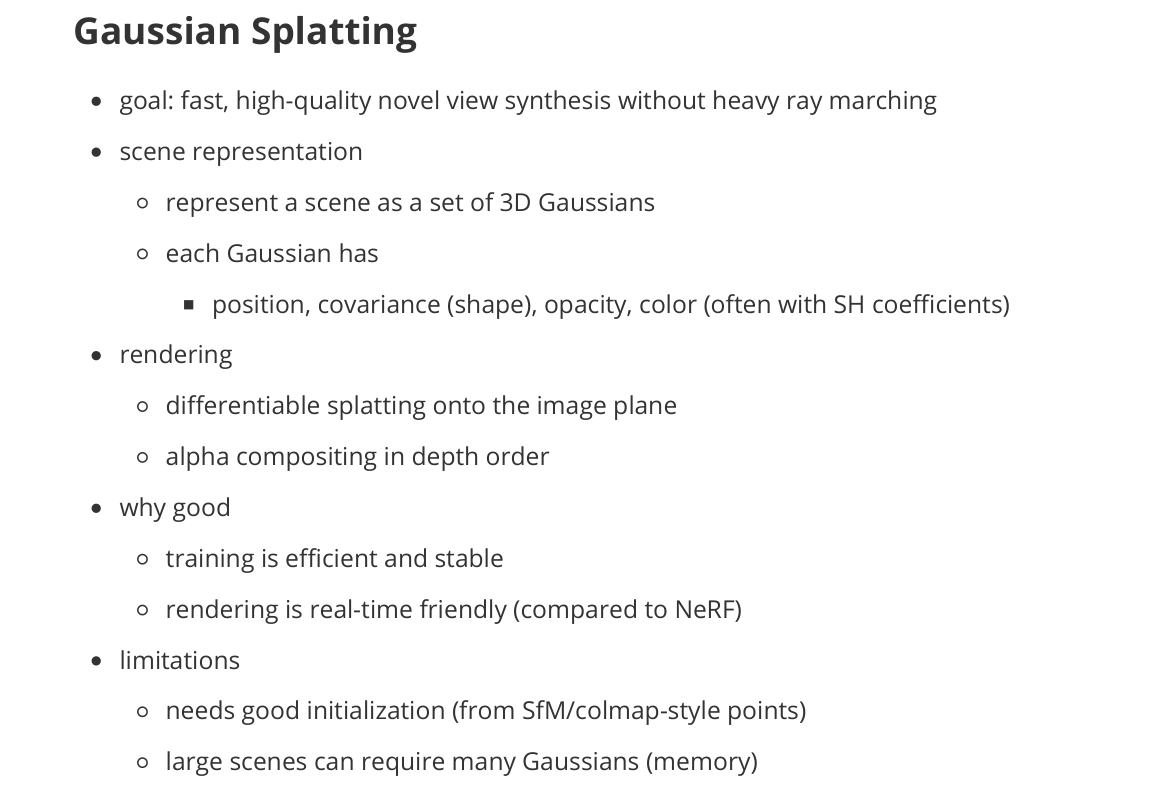
- goal: fast, high-quality novel-view synthesis without heavy ray marching
- scene representation
- represent a scene as a set of 3D Gaussians
- each Gaussian has
- position, covariance (shape), opacity, color (often with SH coefficients)
- rendering
- differentiable splatting onto the image plane
- alpha compositing in depth order
- why good
- training is efficient and stable
- rendering is real-time friendly (compared to NeRF)
- limitations
- needs good initialization (from SfM / colmap-style points)
- large scenes can require many Gaussians (memory)