- These notes were prepared while studying for technical interviews (e.g., Snap Inc., KRAFTON, etc.).
- Each entry contains a concise English summary, key math expressions, and excerpts from my original handwritten/typed study notes.
These notes cover the family of latent-variable and adversarial generative models: how to compress data into representations, how to make those representations probabilistic, and how to train generators by competing against a discriminator.
AutoEncoder
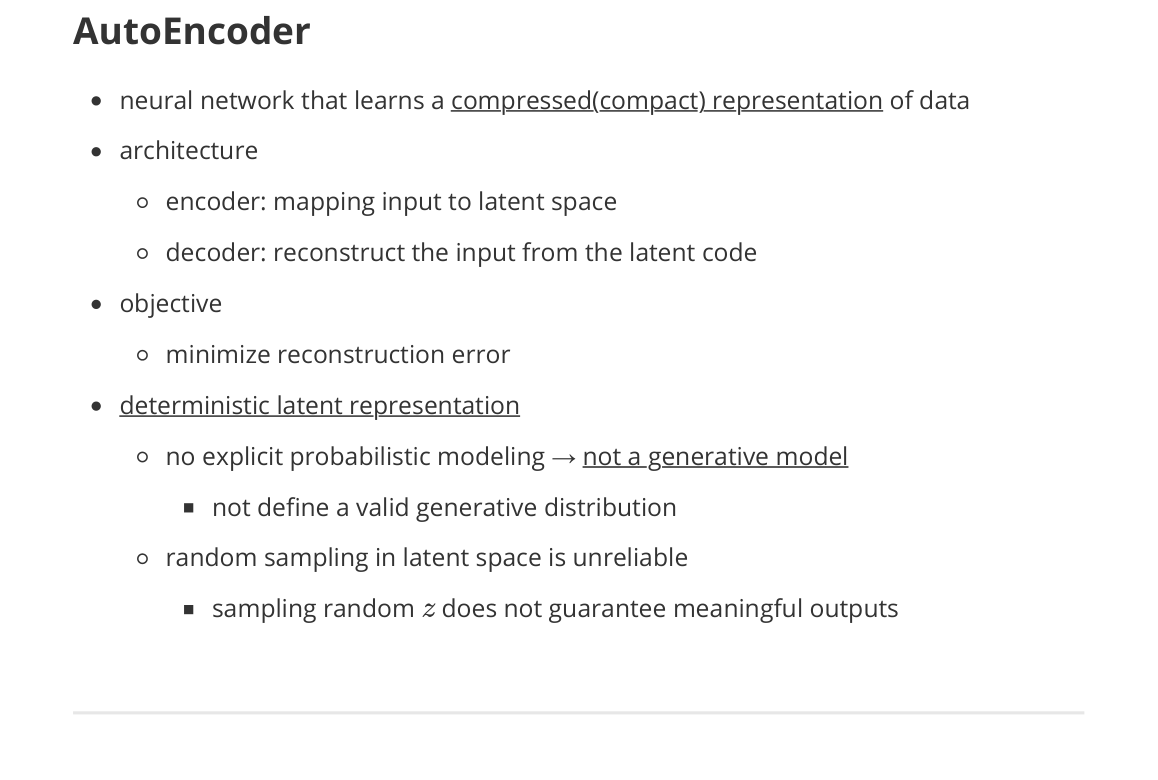
- neural network that learns a compressed (compact) representation of data
Architecture
- Encoder: maps input to latent space
- Decoder: reconstructs the input from the latent code
Objective
- minimize reconstruction error
Deterministic latent representation
- no explicit probabilistic modeling → not a generative model
- does not define a valid generative distribution
- random sampling in latent space is unreliable
- sampling random $z$ does not guarantee meaningful outputs
Variational AutoEncoder (VAE)
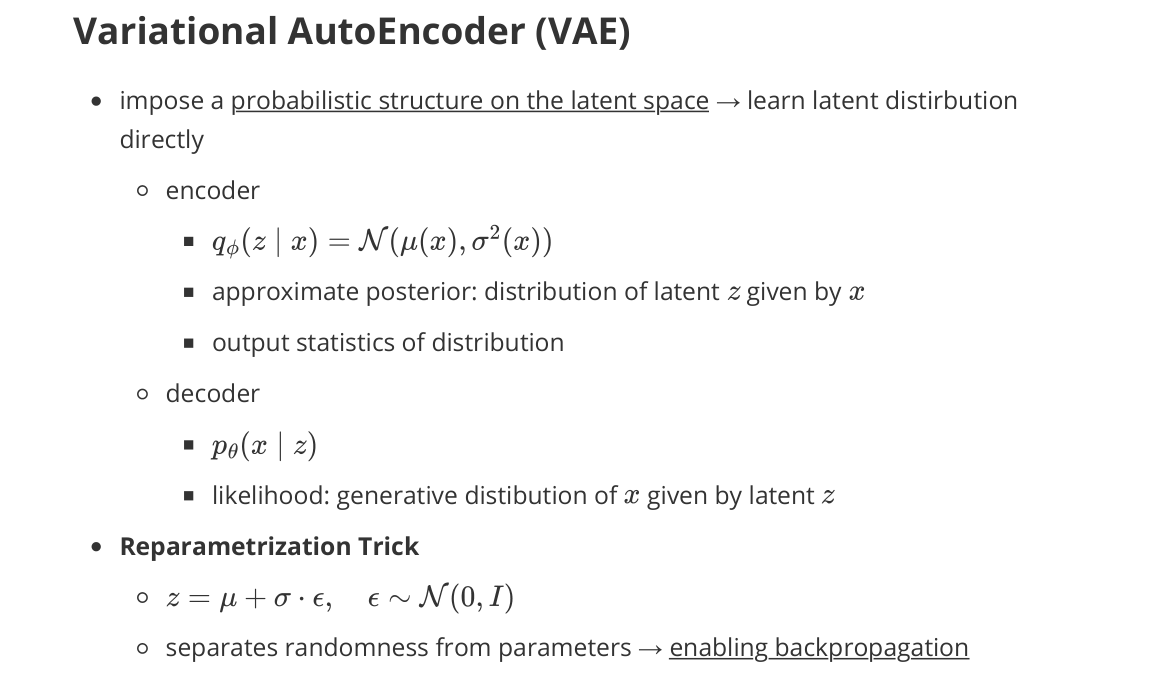
- imposes a probabilistic structure on the latent space → learns a latent distribution directly
Encoder
- $q_\phi(z \mid x) = \mathcal{N}(\mu_\phi(x), \sigma_\phi^2(x))$
- approximate posterior: distribution of latent $z$ given by $x$
- outputs statistics of the distribution
Decoder
- $p_\theta(x \mid z)$
- likelihood: generative distribution of $x$ given by latent $z$
Reparameterization Trick
- separates randomness from parameters → enables backpropagation
- $z = \mu_\phi(x) + \sigma_\phi(x) \odot \epsilon$, $\epsilon \sim \mathcal{N}(0, I)$
Objective
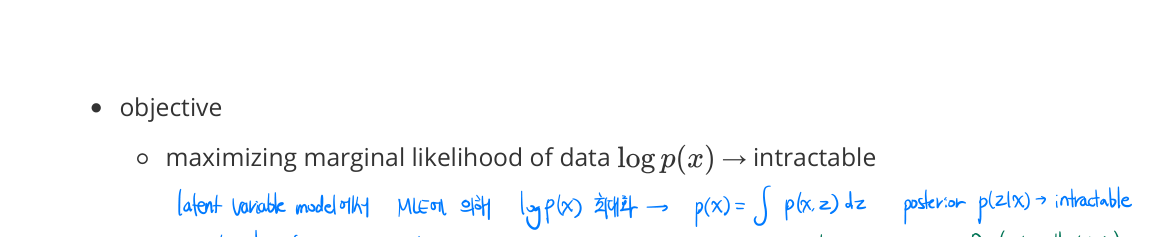
- maximize the marginal log-likelihood of the data: $\log p(x) = \log \int p_\theta(x, z) \, dz$
- intractable in general: the posterior $p(z \mid x)$ is intractable
- → motivates the ELBO (variational lower bound)
ELBO (Evidence Lower BOund)
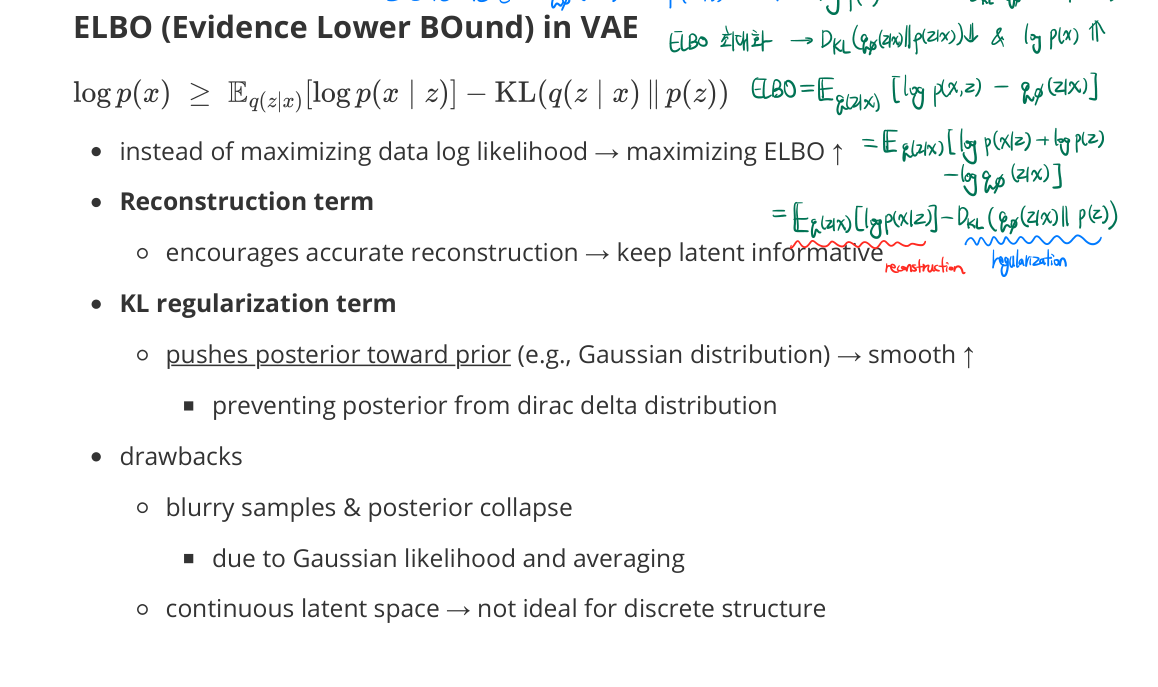
- direct maximization of $\log p(x) = \log \int p_\theta(x, z) \, dz$ is intractable
-
maximize ELBO instead:
\[\log p_\theta(x) \geq \mathbb{E}_{q_\phi(z \mid x)}[\log p_\theta(x \mid z)] - \text{KL}\!\left( q_\phi(z \mid x) \,\big\|\, p(z) \right)\] - Reconstruction term
- encourages accurate reconstruction → keep latent informative
- KL regularization term
- pushes posterior toward prior (e.g., Gaussian distribution) → smooth ↑
- preventing posterior from Dirac delta distribution
- pushes posterior toward prior (e.g., Gaussian distribution) → smooth ↑
Drawbacks
- blurry samples & posterior collapse
- due to Gaussian likelihood and averaging
- continuous latent space → not ideal for discrete structure
Vector-Quantized VAE (VQ-VAE)
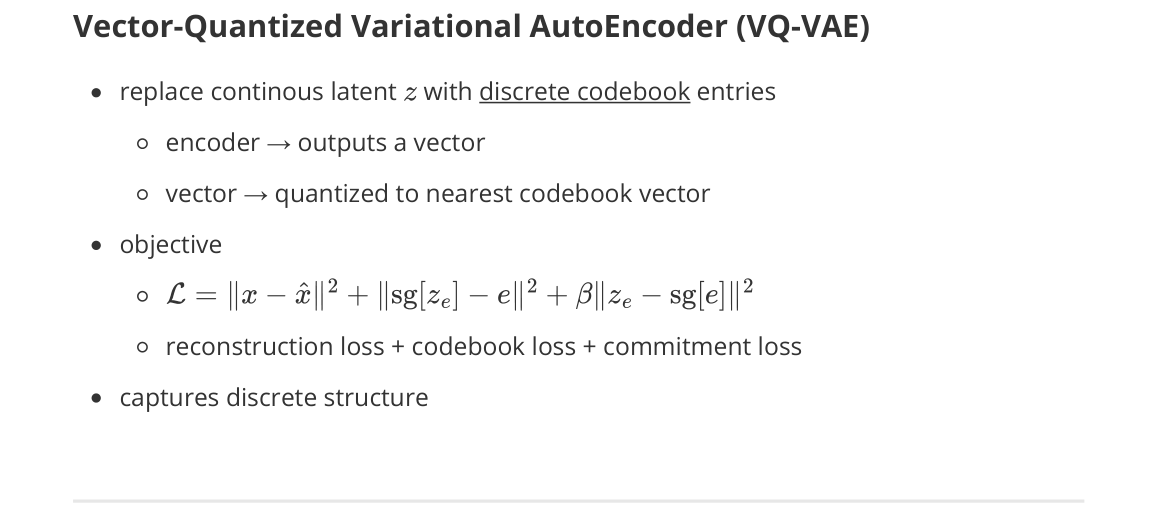
- replace continuous latent $z$ with discrete codebook entries
- encoder → outputs a vector
- vector → quantized to nearest codebook vector
-
objective
\[\mathcal{L} = \|x - \hat{x}\|^2 + \|\operatorname{sg}[z_e] - e\|^2 + \beta \|z_e - \operatorname{sg}[e]\|^2\]- reconstruction loss + codebook loss + commitment loss
- captures discrete structure
Generative Model
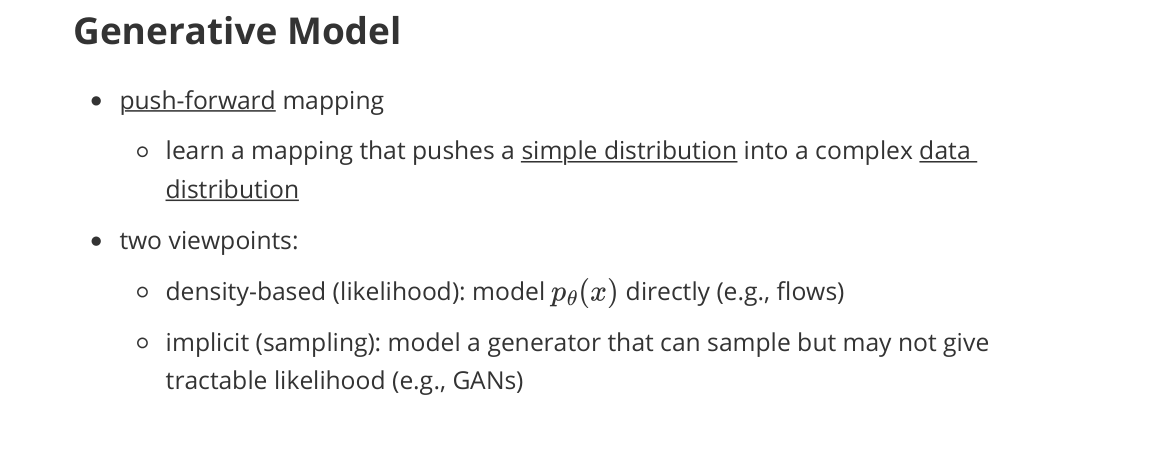
- Push-forward mapping
- learn a mapping that pushes a simple distribution into a complex data distribution
- two viewpoints
- density-based (likelihood): model $p_\theta(x)$ directly (e.g., flows)
- implicit (sampling): model a generator that can sample but may not give tractable likelihood (e.g., GANs)
Evaluation Metrics
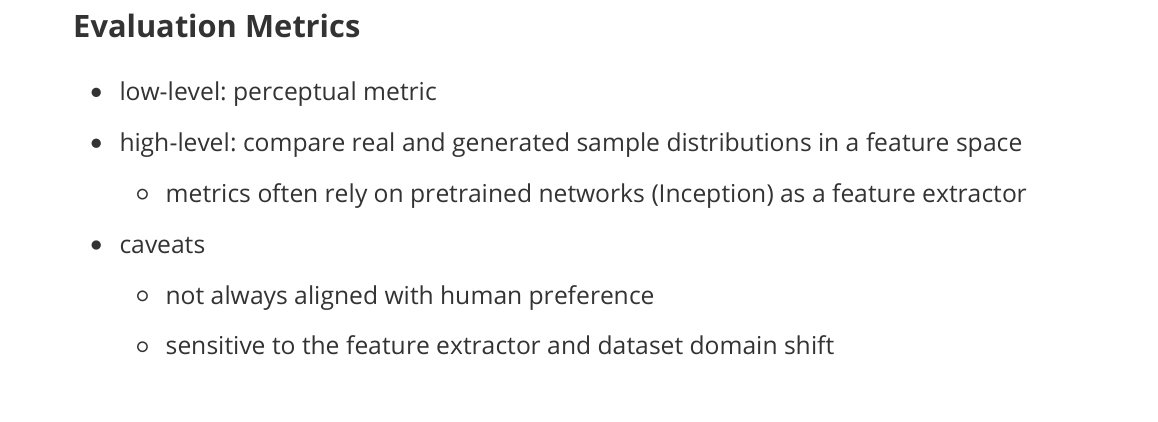
- low-level: perceptual metric
- high-level: compare real and generated sample distributions in a feature space
- metrics often rely on pretrained networks (Inception) as a feature extractor
- caveats
- not always aligned with human preference
- sensitive to the feature extractor and dataset domain shift
Peak Signal-to-Noise Ratio (PSNR)
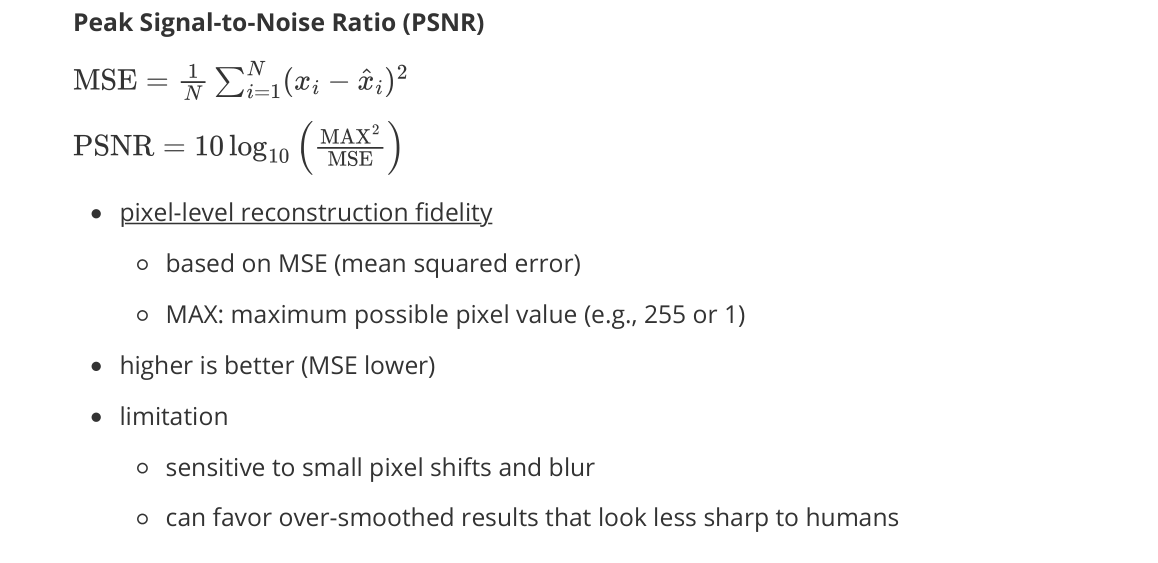
- pixel-level reconstruction fidelity
- based on MSE (mean squared error)
- MAX: maximum possible pixel value (e.g., 255 or 1)
- higher is better (MSE lower)
- limitation
- sensitive to small pixel shifts and blur
- can favor over-smoothed results that look less sharp to humans
Structural Similarity Index (SSIM)
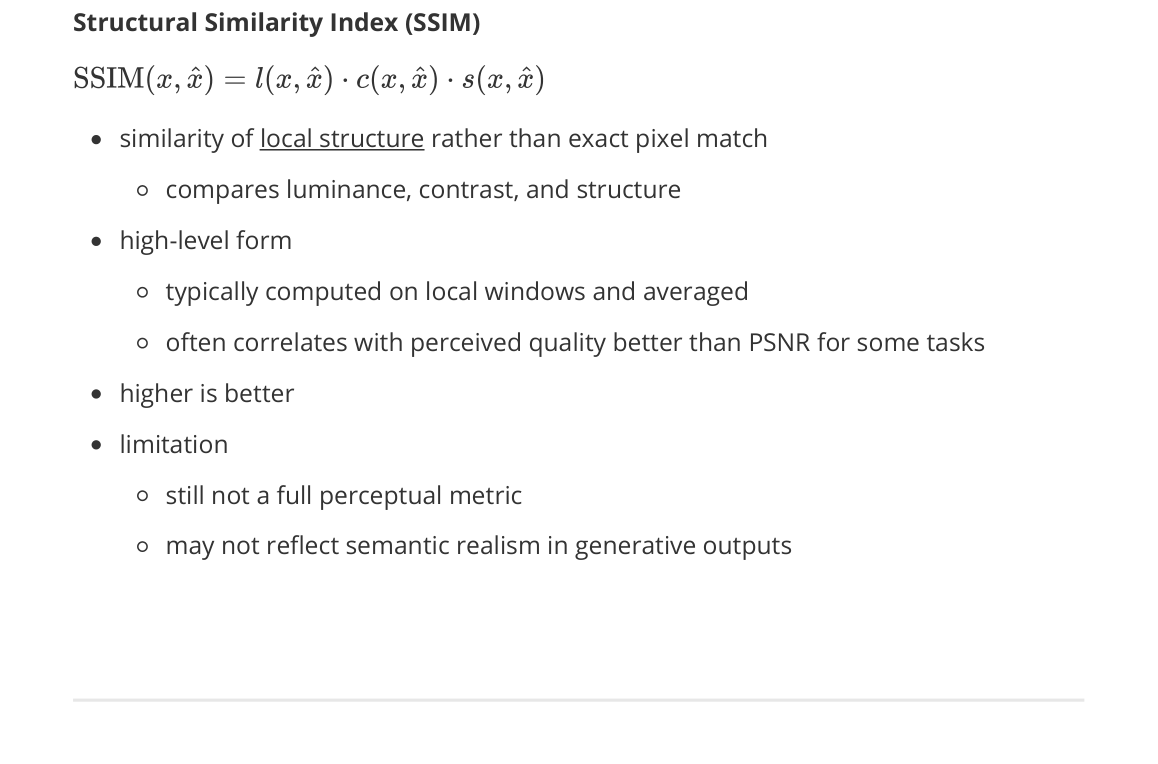
- similarity of local structure rather than exact pixel match
- compares luminance, contrast, and structure
- high-level form
- typically computed on local windows and averaged
- often correlates with perceived quality better than PSNR for some tasks
- higher is better
- limitation
- still not a full perceptual metric
- may not reflect semantic realism in generative outputs
Fréchet Inception Distance (FID)
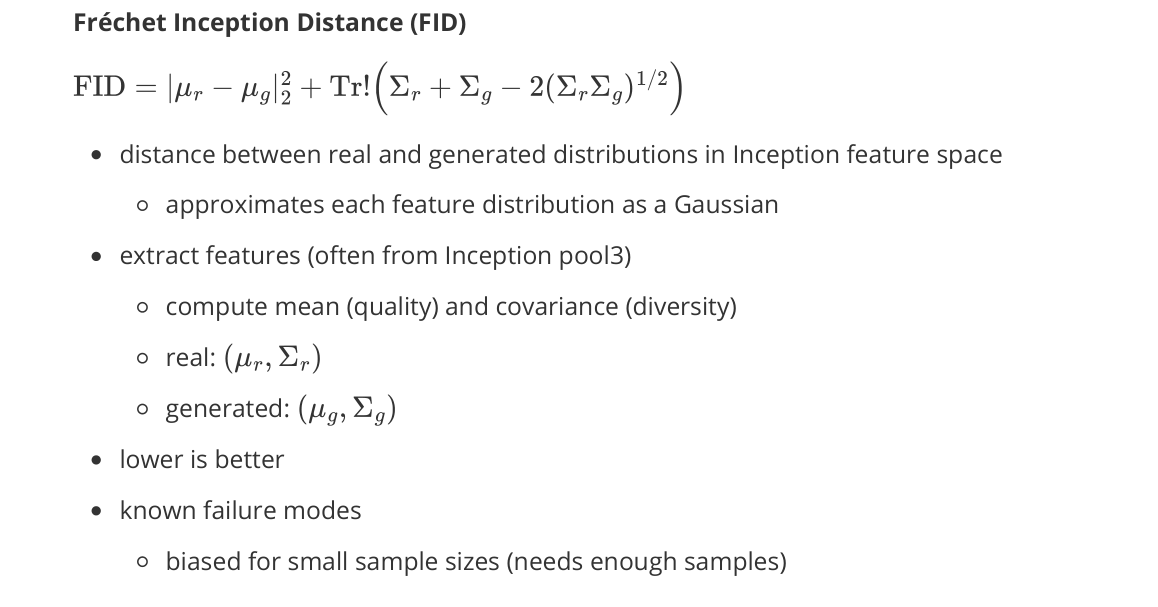

- distance between real and generated distributions in Inception feature space
- approximates each feature distribution as a Gaussian
- extract features (often from Inception pool3)
- compute mean (quality) and covariance (diversity)
- real: $(\mu_r, \Sigma_r)$
- generated: $(\mu_g, \Sigma_g)$
- lower is better
- known failure modes
- biased for small sample sizes (needs enough samples)
- can be gamed if feature extractor is inappropriate
Inception Score
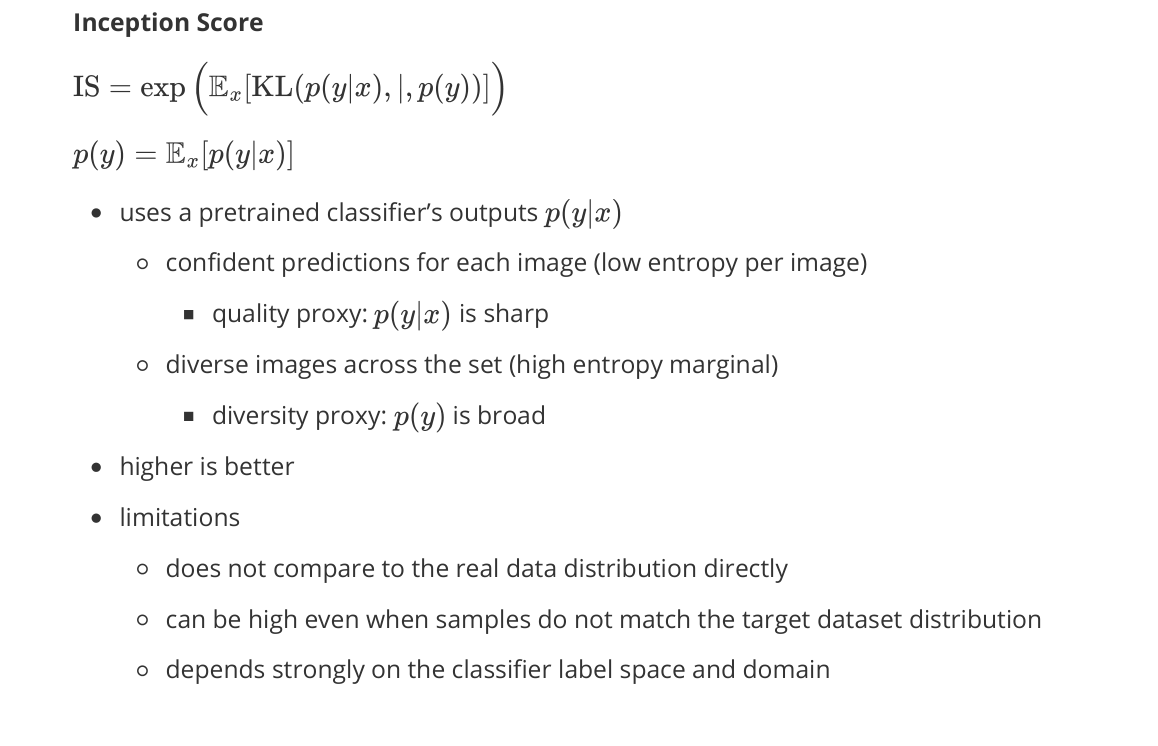
- uses a pretrained classifier’s outputs $p(y \mid x)$
- confident predictions for each image (low entropy per image)
- quality proxy: $p(y \mid x)$ is sharp
- diverse images across the set (high entropy marginal)
- diversity proxy: $p(y)$ is broad
- confident predictions for each image (low entropy per image)
- higher is better
- limitations
- does not compare to the real data distribution directly
- can be high even when samples do not match the target dataset distribution
- depends strongly on the classifier label space and domain
Learned Perceptual Image Patch Similarity (LPIPS)
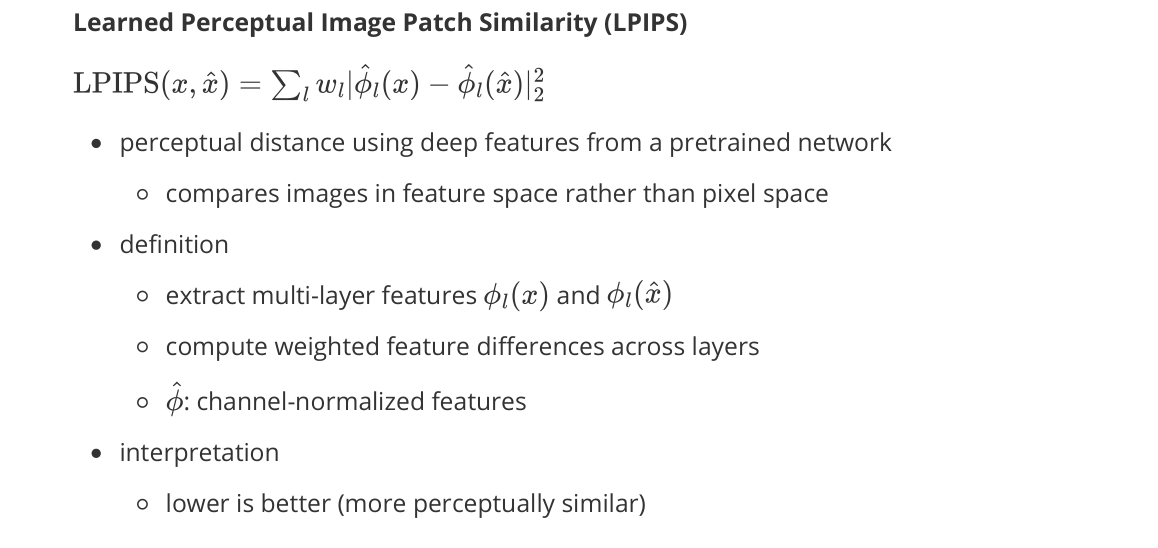
- perceptual distance using deep features from a pretrained network
- compares images in feature space rather than pixel space
- definition
- extract multi-layer features $\phi_l(x)$ and $\phi_l(\hat{x})$
- compute weighted feature differences across layers
- $\hat{\phi}$: channel-normalized features
- interpretation
- lower is better (more perceptually similar)
- commonly used for image-to-image translation, restoration, diffusion reconstruction quality
- limitation
- depends on the backbone and training domain
- not a distribution metric (unlike FID): it’s a pairwise similarity metric
Generative Adversarial Network (GAN)
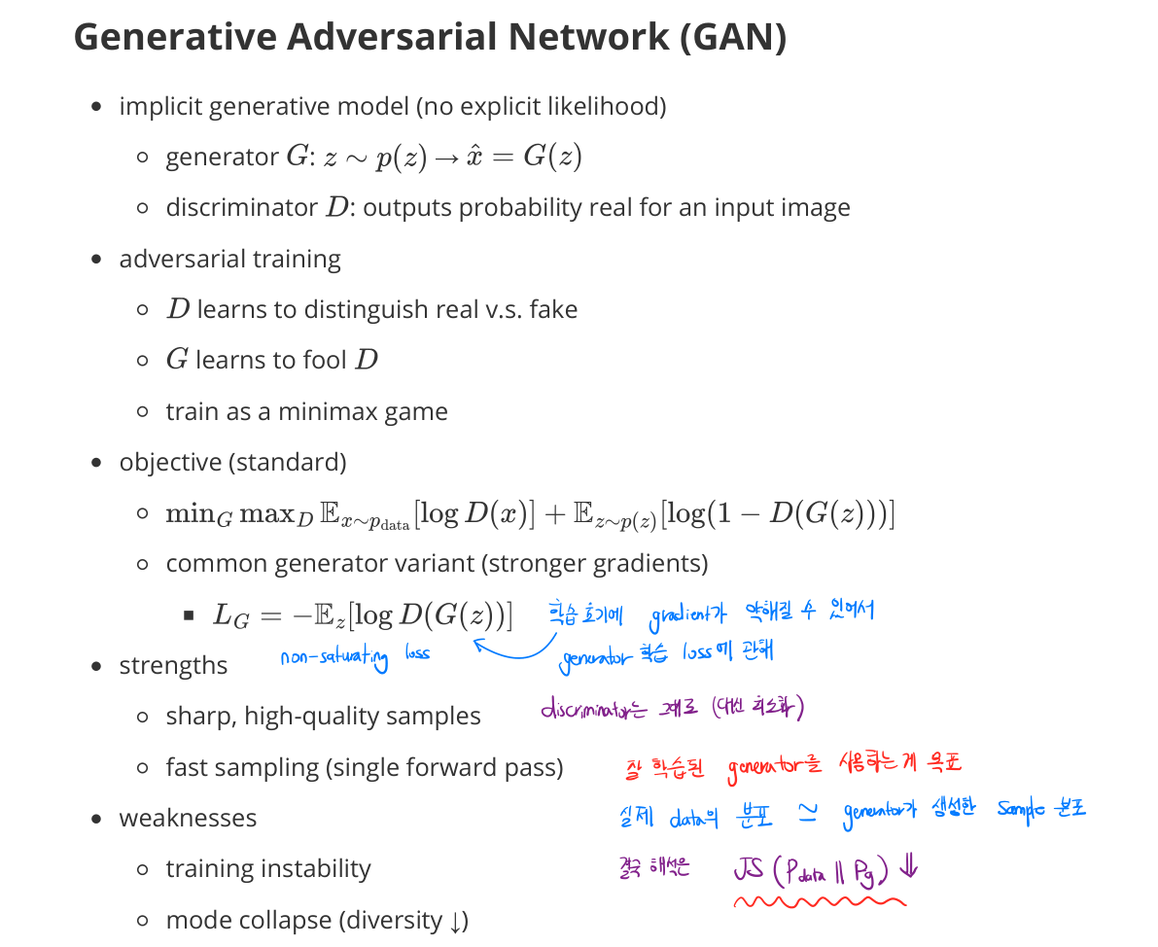
- implicit generative model (no explicit likelihood)
- generator $G$: $z \sim p(z) \to \hat{x} = G(z)$
- discriminator $D$: outputs probability real for an input image
Adversarial training
- $D$ learns to distinguish real v.s. fake
- $G$ learns to fool $D$
- train as a minimax game
Objective (standard)
- \[\min_G \max_D \; \mathbb{E}_{x \sim p_{\text{data}}}[\log D(x)] + \mathbb{E}_{z \sim p(z)}[\log(1 - D(G(z)))]\]
- common generator variant (stronger gradients early in training)
- $\mathcal{L}_G = -\mathbb{E}_z[\log D(G(z))]$: non-saturating loss
Strengths
- sharp, high-quality samples
- fast sampling (single forward pass)
Weaknesses
- training instability
- mode collapse (diversity ↓)
Wasserstein GAN (WGAN)

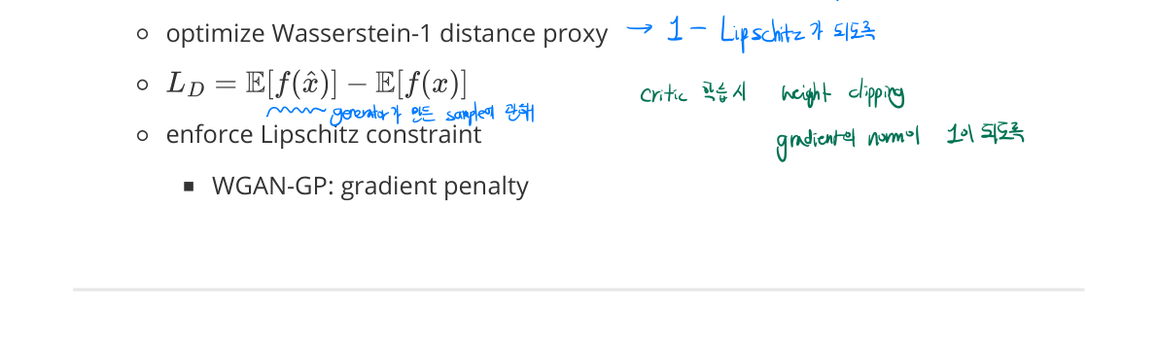
- replace discriminator with a critic $D$ (no sigmoid)
- optimize Wasserstein-1 distance proxy
- critic loss: $\mathcal{L}_D = \mathbb{E}[f(\hat{x})] - \mathbb{E}[f(x)]$
- enforce Lipschitz constraint (weight clipping or gradient penalty)
- WGAN-GP: gradient penalty on the critic
- mitigates issues where the supports of $p_{\text{data}}$ and $p_g$ don’t overlap → unstable generator training