- These notes were prepared while studying for technical interviews (e.g., Snap Inc., KRAFTON, etc.).
- Each entry contains a concise English summary, key math expressions, and excerpts from my original handwritten/typed study notes.
These notes cover the foundations of discriminative classification and the information-theoretic objectives that drive most learning losses.
Support Vector Machine (SVM)
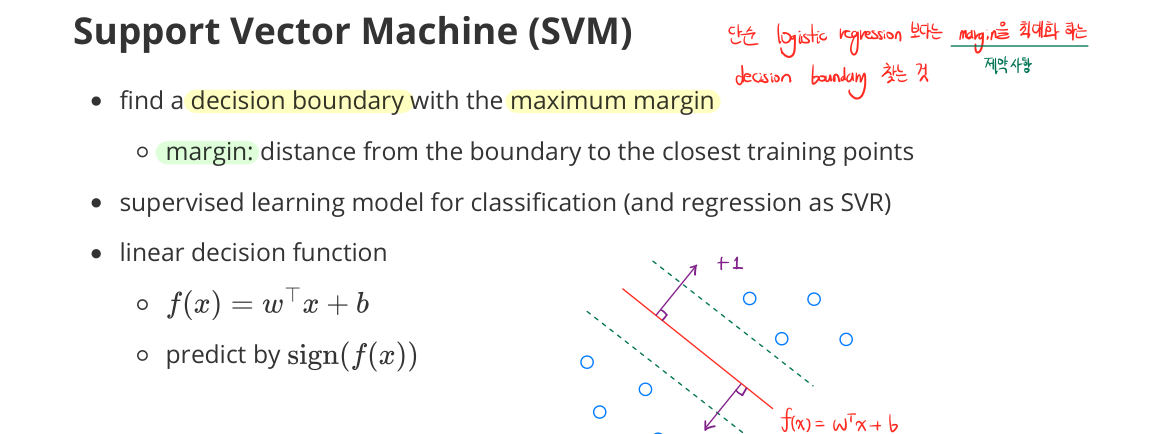
- find a decision boundary with the maximum margin
- margin: distance from the boundary to the closest training points
- supervised learning model for classification (and regression as SVR)
- linear decision function
- $f(x) = w^\top x + b$
- predict by $\operatorname{sign}(f(x))$
Maximum-Margin (Hard Margin)
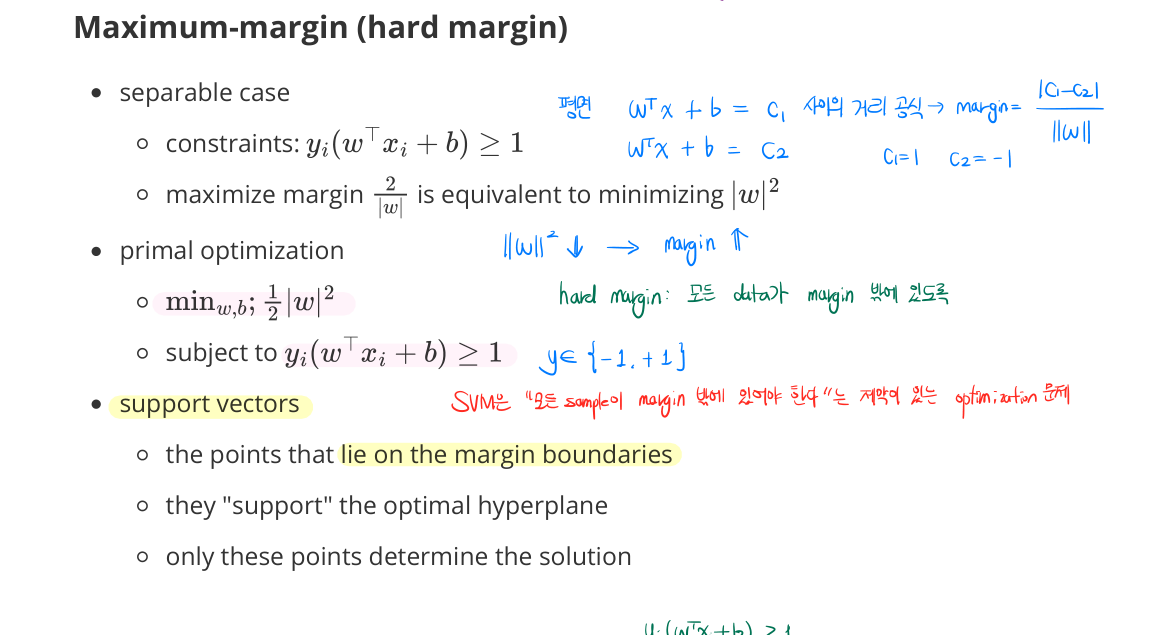
- separable case
- constraints: $y_i(w^\top x_i + b) \geq 1$
- maximize margin $\frac{2}{|w|}$ is equivalent to minimizing $\frac{1}{2}|w|^2$
-
primal optimization:
\[\min_{w,b} \tfrac{1}{2}\|w\|^2 \quad \text{s.t.} \quad y_i(w^\top x_i + b) \geq 1\] - Support vectors
- the points that lie on the margin boundaries
- they “support” the optimal hyperplane
- only these points determine the solution
Soft Margin (Non-Separable)
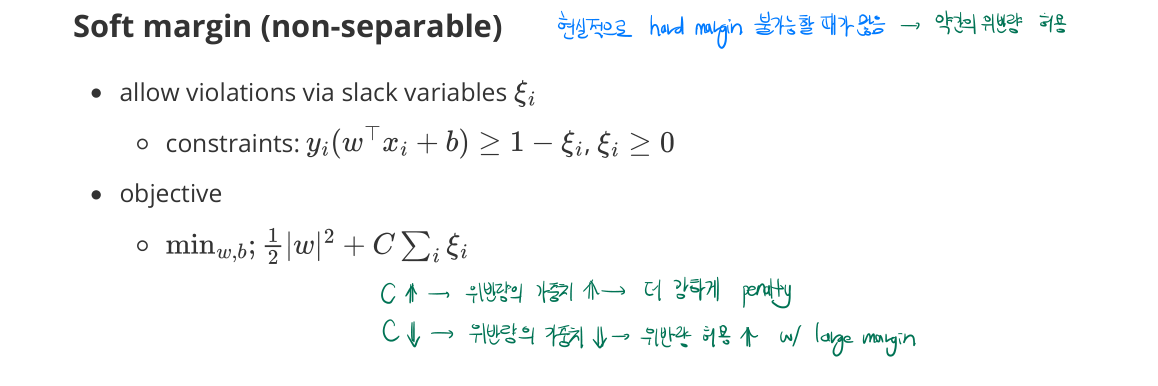
- allow violations via slack variables $\xi_i \geq 0$
- constraints: $y_i(w^\top x_i + b) \geq 1 - \xi_i$
-
objective:
\[\min_{w,b,\xi} \tfrac{1}{2}\|w\|^2 + C \sum_i \xi_i\] - $C$ controls tradeoff
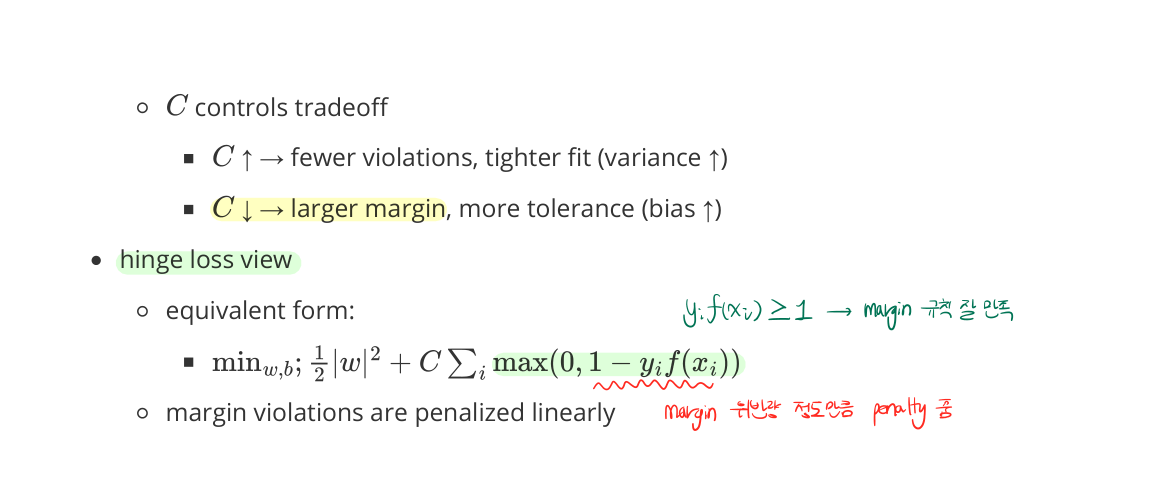
- $C \uparrow$ → fewer violations, tighter fit (variance ↑)
- $C \downarrow$ → larger margin, more tolerance (bias ↑)
-
hinge loss view:
\[\min_{w,b} \tfrac{1}{2}\|w\|^2 + C \sum_i \max(0, 1 - y_i f(x_i))\] - margin violations are penalized linearly
Kernel Trick
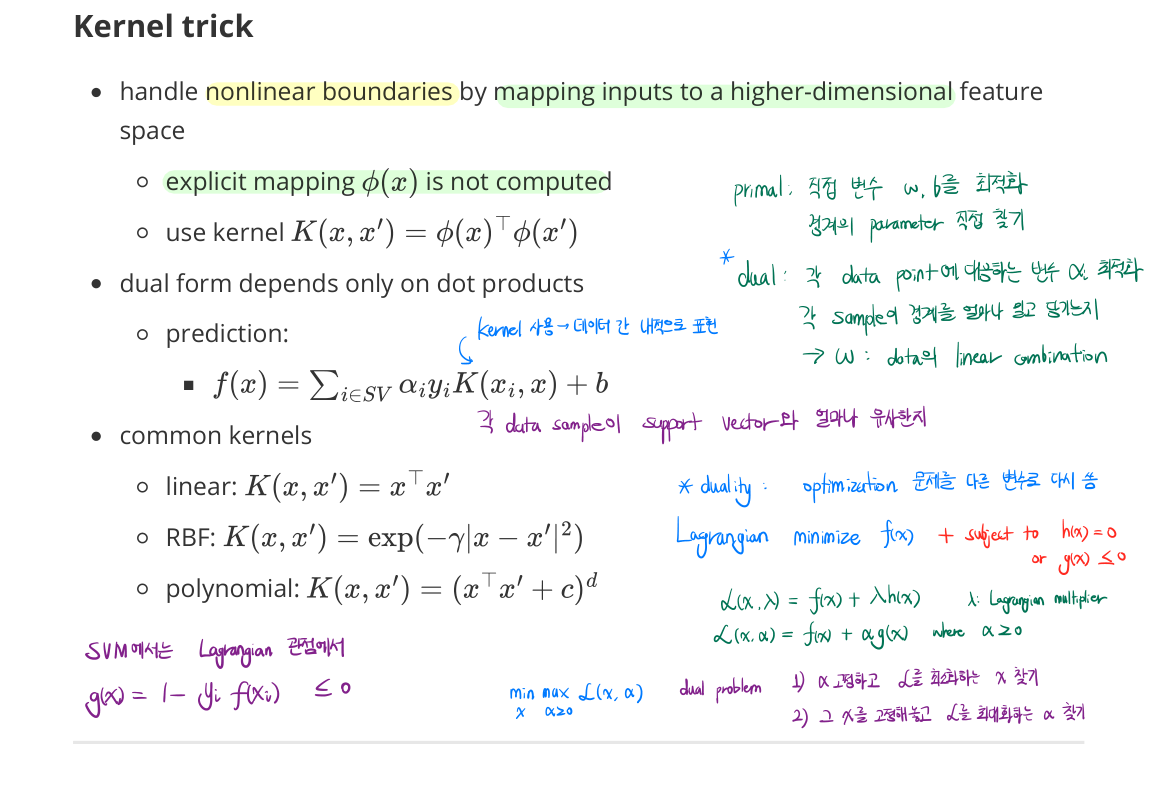
- handle nonlinear boundaries by mapping inputs to a higher-dimensional feature space
- explicit mapping $\phi(x)$ is not computed
- use kernel $K(x, x’) = \phi(x)^\top \phi(x’)$
- dual form depends only on dot products
- prediction:
- $f(x) = \sum_{i \in \text{SV}} \alpha_i y_i K(x_i, x) + b$
- prediction:
- common kernels
- linear: $K(x, x’) = x^\top x’$
- RBF: $K(x, x’) = e^{-\gamma |x - x’|^2}$
- polynomial: $K(x, x’) = (x^\top x’ + c)^d$
Logit & Softmax
Logit
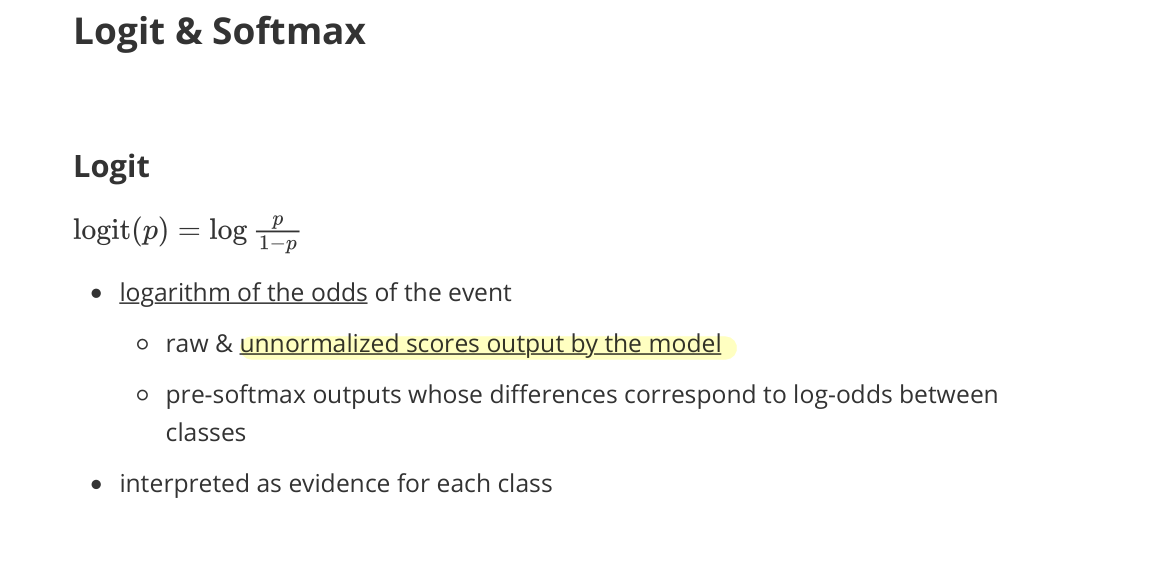
- logarithm of the odds of the event
- raw & unnormalized scores output by the model
- pre-softmax outputs whose differences correspond to log-odds between classes
- interpreted as evidence for each class
Softmax
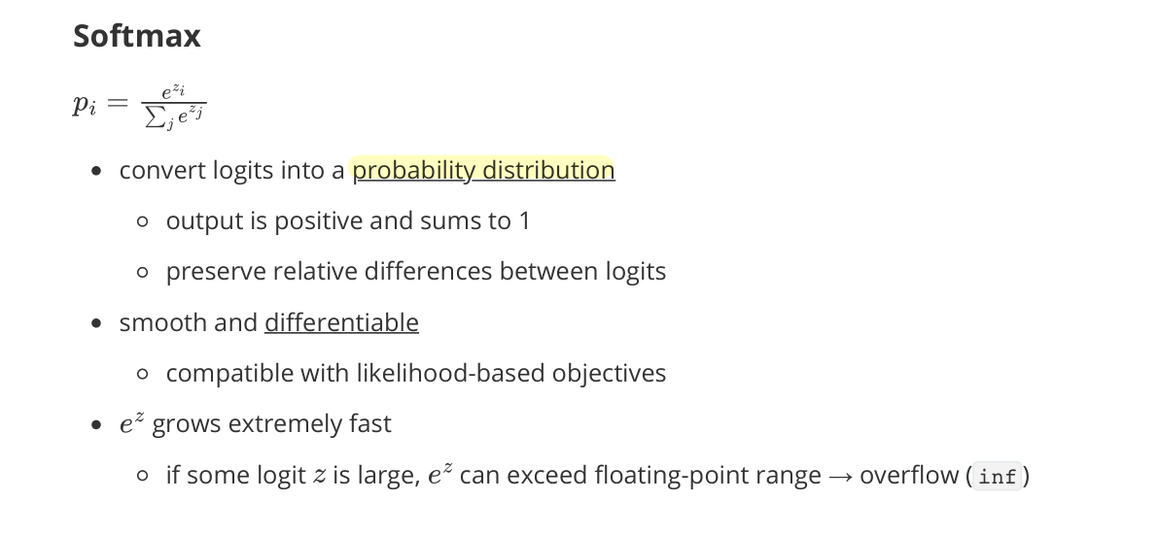
- convert logits into a probability distribution
- output is positive and sums to 1
- preserve relative differences between logits
- smooth and differentiable
- compatible with likelihood-based objectives
- $e^{z}$ grows extremely fast
- if some logit $z$ is large, $e^{z}$ can exceed floating-point range → overflow (
inf)
- if some logit $z$ is large, $e^{z}$ can exceed floating-point range → overflow (
Log-Sum-Exp Trick
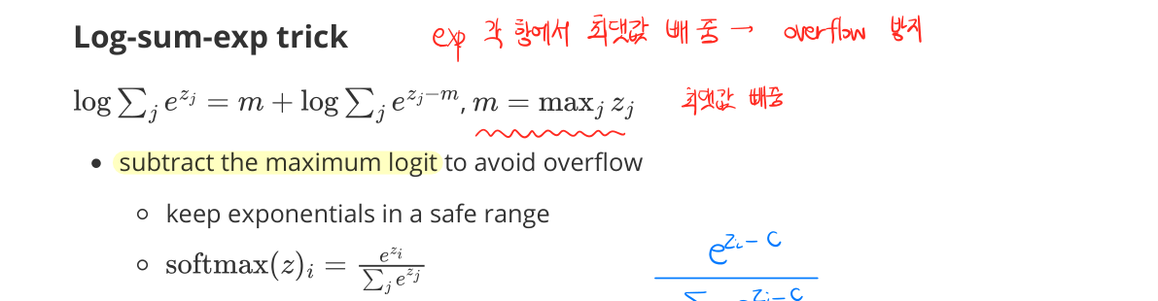
- subtract the maximum logit to avoid overflow
- keeps exponentials in a safe range
Gumbel Softmax
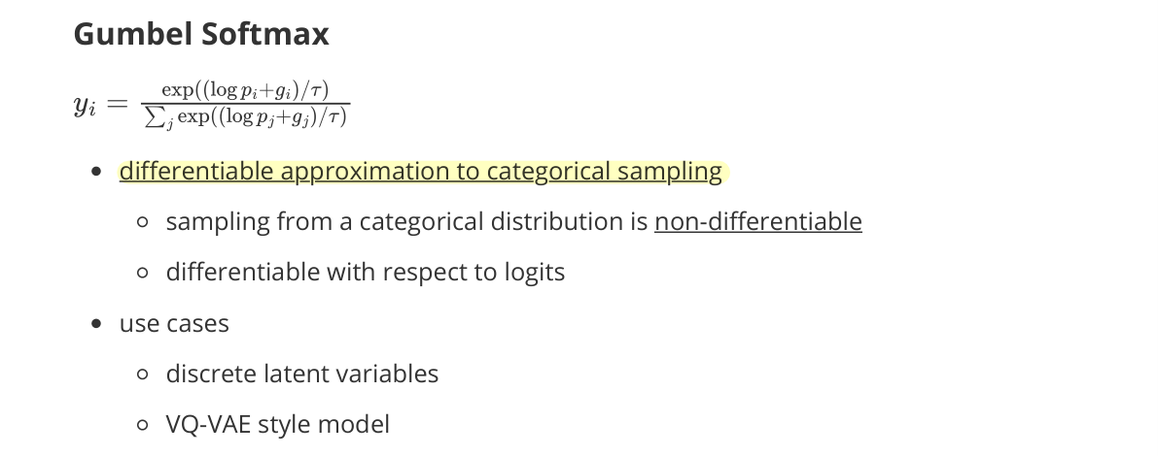
- differentiable approximation to categorical sampling
- sampling from a categorical distribution is non-differentiable
- differentiable with respect to logits
- use cases
- discrete latent variables
- VQ-VAE style models
Entropy
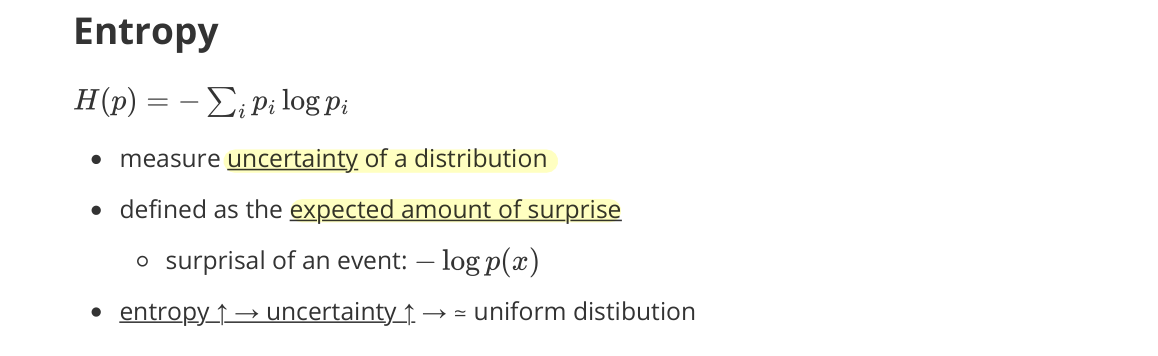
- measure uncertainty of a distribution
- defined as the expected amount of surprise
- surprisal of an event: $-\log p(x)$
- entropy ↑ → uncertainty ↑ → ≃ uniform distribution
- entropy ↓ → more confident or peaked distribution → ≃ deterministic distribution
Cross-Entropy
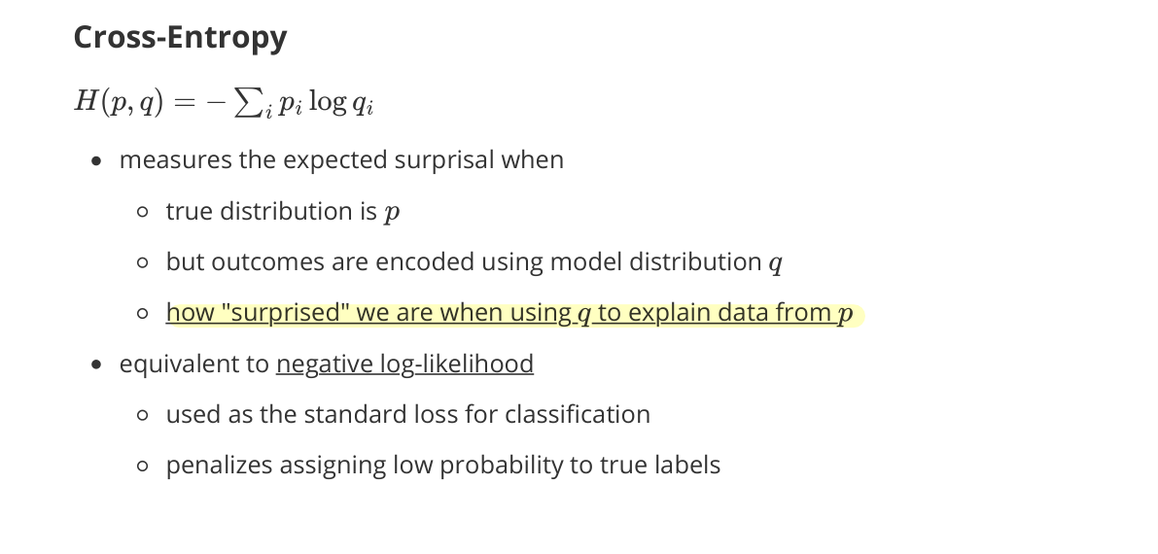
- measures the expected surprisal when
- true distribution is $p$
- but outcomes are encoded using model distribution $q$
- how “surprised” we are when using $q$ to explain data from $p$
- equivalent to negative log-likelihood
- used as the standard loss for classification
- penalizes assigning low probability to true labels
KL Divergence
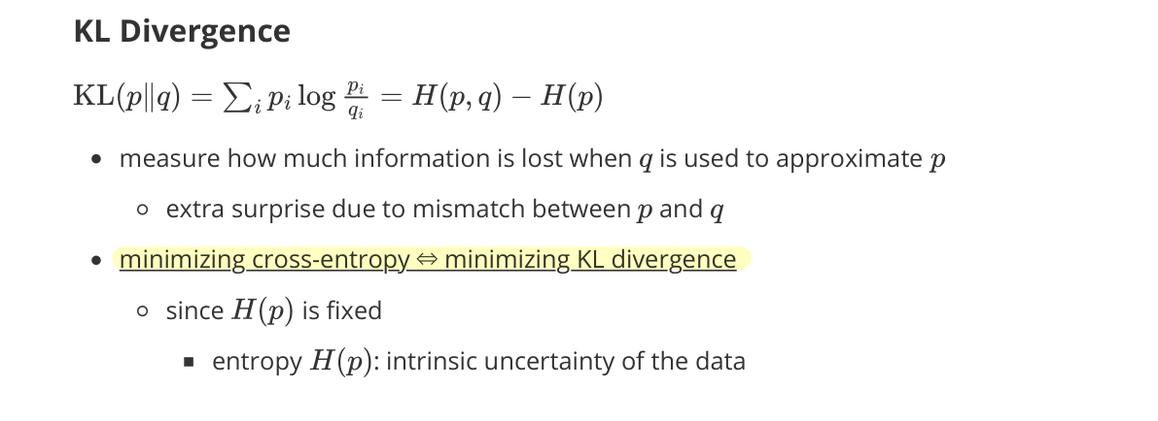
- measure how much information is lost when $q$ is used to approximate $p$
- extra surprise due to mismatch between $p$ and $q$
- minimizing cross-entropy ⇔ minimizing KL divergence
- since $H(p)$ is fixed
- entropy $H(p)$: intrinsic uncertainty of the data
- since $H(p)$ is fixed