- These notes were prepared while studying for technical interviews (e.g., Snap Inc., KRAFTON, etc.).
- Each entry contains a concise English summary, key math expressions, and excerpts from my original handwritten/typed study notes.
These notes cover the convolutional building blocks that power modern computer-vision architectures, and the residual learning idea that made training very deep networks possible.
Convolutional Neural Networks (CNN)
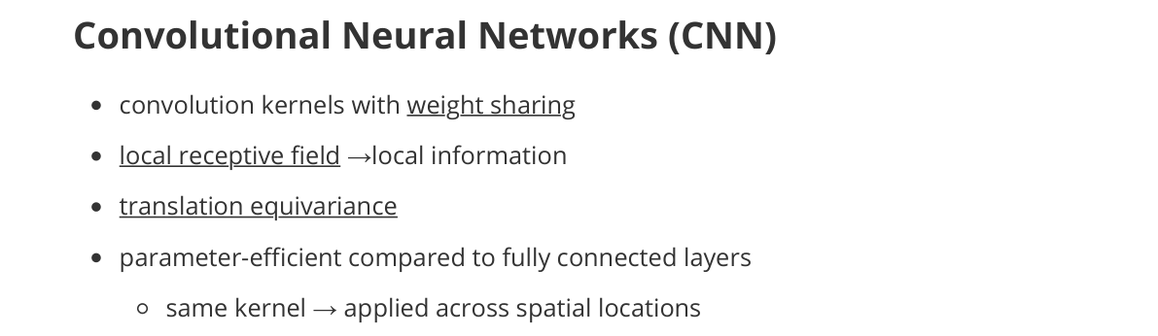
- convolution kernels with weight sharing
- local receptive field → local information
- translation equivariance
- parameter-efficient compared to fully connected layers
- same kernel → applied across spatial locations
Downsampling
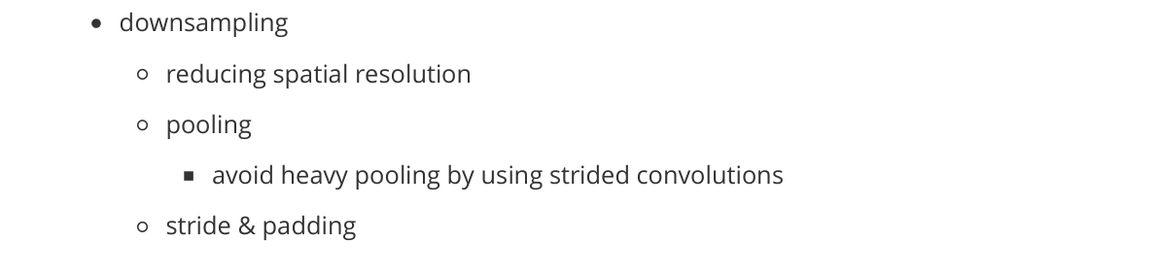

- reducing spatial resolution
- pooling
- avoid heavy pooling by using strided convolutions
- stride & padding: output size = $(H_{\text{in}} - k_H) / s + 1$
- batch normalization → optimization ↑ (also acts as a regularizer)
Convolution Variants
Standard convolution
- parameters: $C_{\text{in}} \cdot C_{\text{out}} \cdot k_H \cdot k_W$
Depthwise Convolution
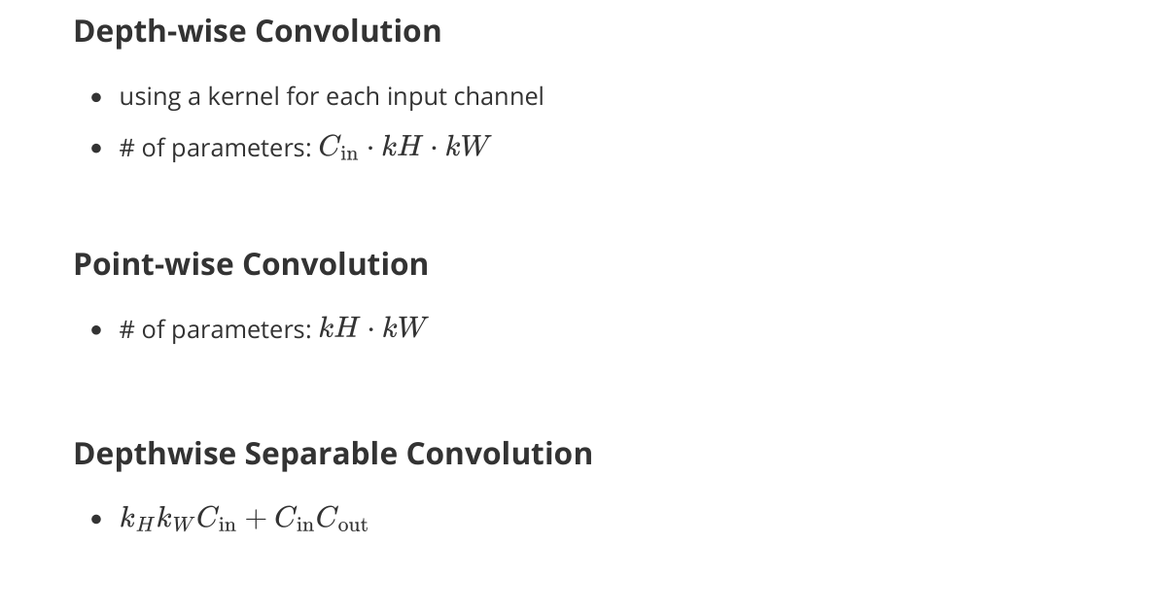
- using a kernel for each input channel
- parameters: $C_{\text{in}} \cdot k_H \cdot k_W$
Pointwise Convolution
- $1 \times 1$ convolution
- parameters: $C_{\text{in}} \cdot C_{\text{out}}$
Depthwise Separable Convolution
- depthwise + pointwise → mixing spatial and channel-wise computations cheaply
- parameters: $k_H k_W C_{\text{in}} + C_{\text{in}} C_{\text{out}}$
Adaptive Average Pooling
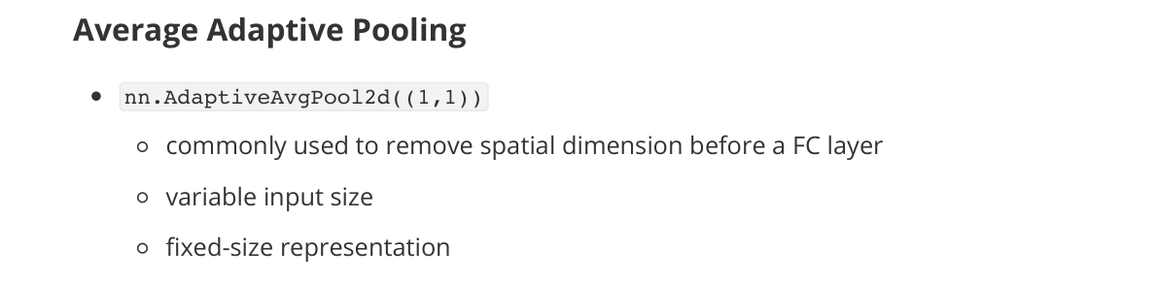
nn.AdaptiveAvgPool2d((1,1))- commonly used to remove spatial dimension before a FC layer
- variable input size
- fixed-size representation
ResNet
- CNN architecture built from residual blocks
- enables training of very deep networks
Key idea
- learn a residual function instead of a full mapping
- output: $y = F(x) + x$
- where $F(x)$ is a stack of conv + norm + activation layers
Why it helps (intuition)
- if the optimal mapping is close to identity, it is easier to learn $F(x) \approx 0$
- gradients can flow through the skip path directly → vanishing gradient ↓
Typical block types
- Basic block: two $3 \times 3$ conv layers
- Bottleneck block: $1 \times 1$ → $3 \times 3$ → $1 \times 1$ (compute-efficient)
Common details
- if shapes differ, use a projection shortcut
- $y = F(x) + W_s x$ (e.g., $1 \times 1$ conv with stride)
Residual Connection

- add an identity (skip) path to the main transformation
Effects
- optimization becomes easier
- skip path provides a low-resistance gradient route
- improves conditioning
- reduces sensitivity to depth in practice
- allows deeper models without degradation
Where used
- ResNet blocks
- Transformers (residual around attention and MLP)
- Diffusion U-Nets (skip connections across scales)