- These notes were prepared while studying for technical interviews (e.g., Snap Inc., KRAFTON, etc.).
- Each entry contains a concise English summary, key math expressions, and excerpts from my original handwritten/typed study notes.
These notes cover the core ML concepts that determine how a model generalizes and trains. The sections trace the bias/variance decomposition, the regularization techniques used to control capacity, the normalization layers that stabilize training, and dropout as a stochastic regularizer.
Bias v.s. Variance
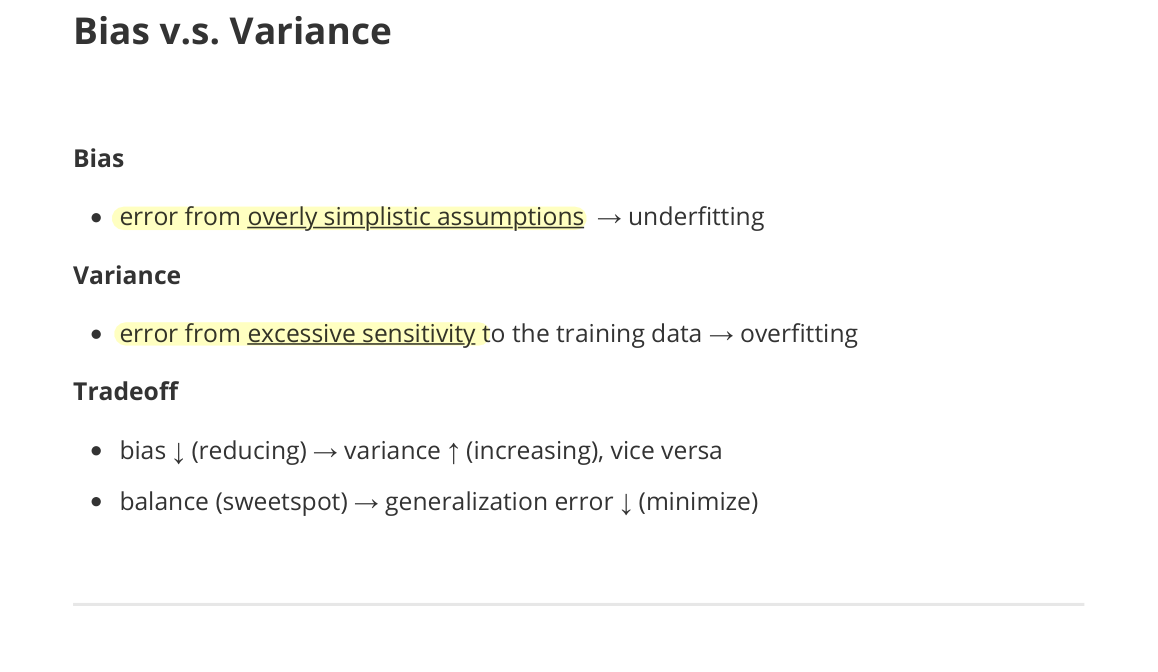
- Bias
- error from overly simplistic assumptions → underfitting
- Variance
- error from excessive sensitivity to the training data → overfitting
- Tradeoff
- bias ↓ (reducing) → variance ↑ (increasing), vice versa
- balance (sweetspot) → generalization error ↓ (minimize)
Overfitting & Regularization
- Overfitting
- learning a noise (pattern) specific to the training data, rather than generalizable features
- Techniques for mitigating overfitting: regularization, dropout, early stopping, cross-validation
Regularization
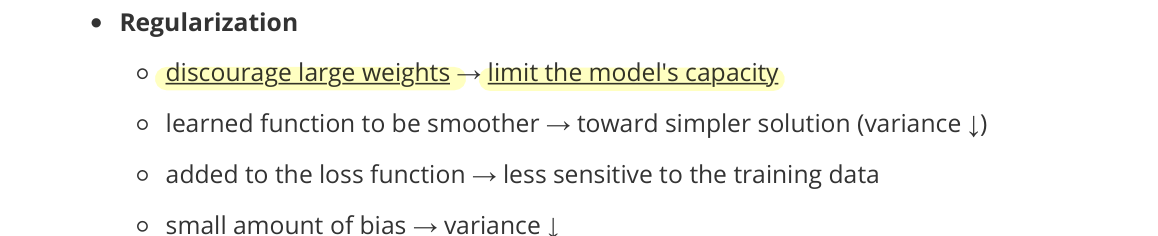
- discourage large weights → limit the model’s capacity
- learned function becomes smoother → toward simpler solution (variance ↓)
- added to the loss function → less sensitive to the training data
- a small amount of bias added → variance ↓
L2 (Ridge regression)

- penalty proportional to the squared magnitude of the weights
- soft penalty
- Gaussian prior (MAP perspective)
L1 (Lasso)

- penalty on the absolute values of the weights
- hard penalty → encourages sparsity in weights
- non-differentiable at 0 → robust to outliers but unstable optimization
- Laplace prior (MAP perspective)
Dropout (as a regularizer)

- randomly disabling perceptrons → preventing the network from relying too heavily on specific activations
- more robust representations
Early Stopping

- monitoring validation performance → stopping training before overfitting
- preventing the model from fitting noise → complexity ↓
Cross-Validation
- partition the training data into K folds → train on K−1 folds, validate on the held-out one
- less biased estimate of generalization error → tune hyperparameters without leaking the test set
Normalization
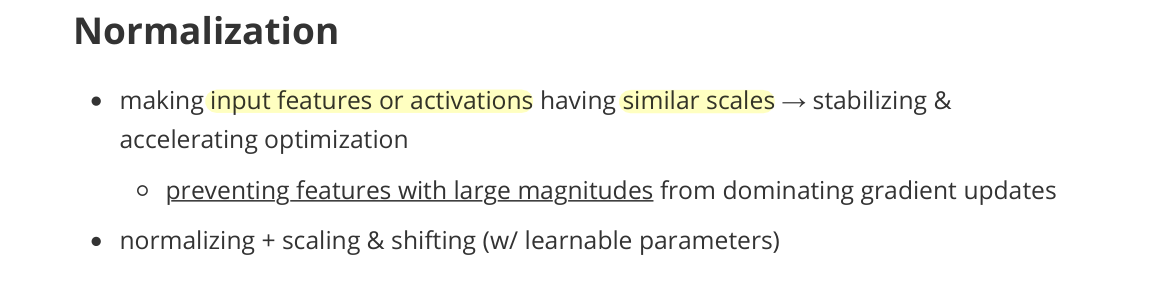
- making input features or activations have similar scales → stabilizing and accelerating optimization
- preventing features with large magnitudes from dominating gradient updates
- normalizing + scaling and shifting (with learnable parameters)
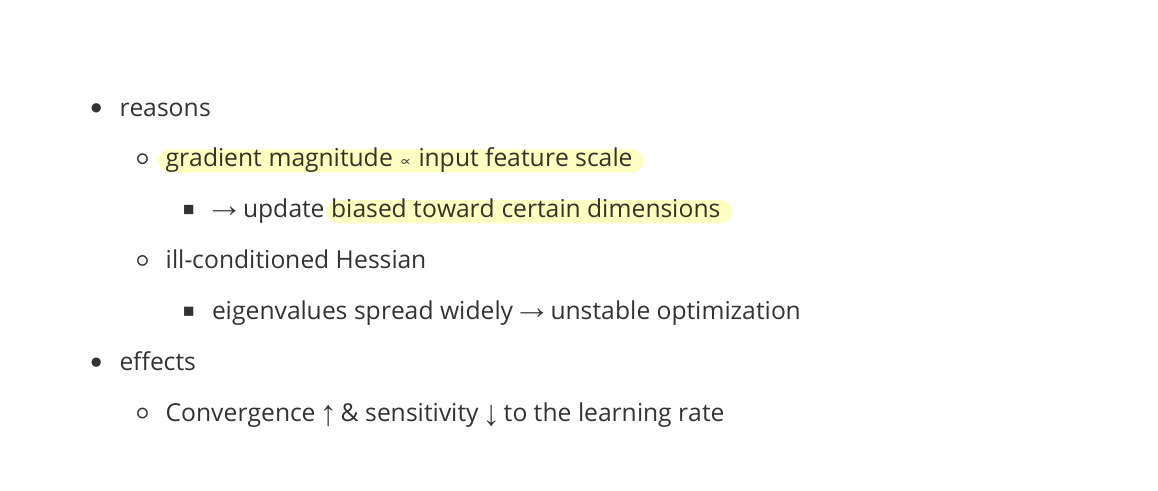
Reasons
- gradient magnitude $\propto$ input feature scale → update biased toward certain dimensions
- ill-conditioned Hessian
- eigenvalues spread widely → unstable optimization
Effects
- convergence ↑ and sensitivity ↓ to the learning rate
Common template: most normalization variants follow this with different statistics:
\[\hat{x} = \frac{x - \mu}{\sqrt{\sigma^2 + \epsilon}}, \qquad y = \gamma \hat{x} + \beta\]Feature Normalization
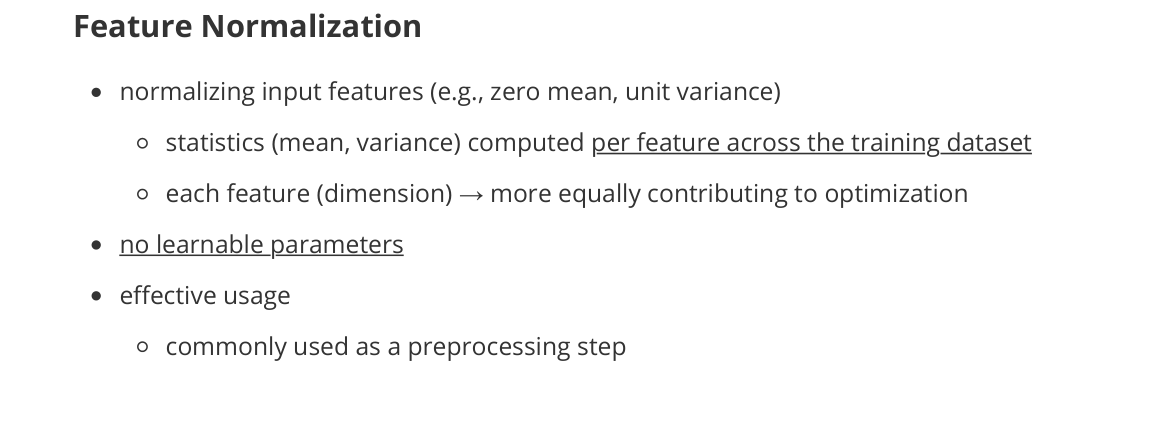
- normalizing input features (e.g., zero mean, unit variance)
- statistics (mean, variance) computed per feature across the training dataset
- each feature (dimension) → more equally contributing to optimization
- no learnable parameters
- effective usage
- commonly used as a preprocessing step
Batch Normalization
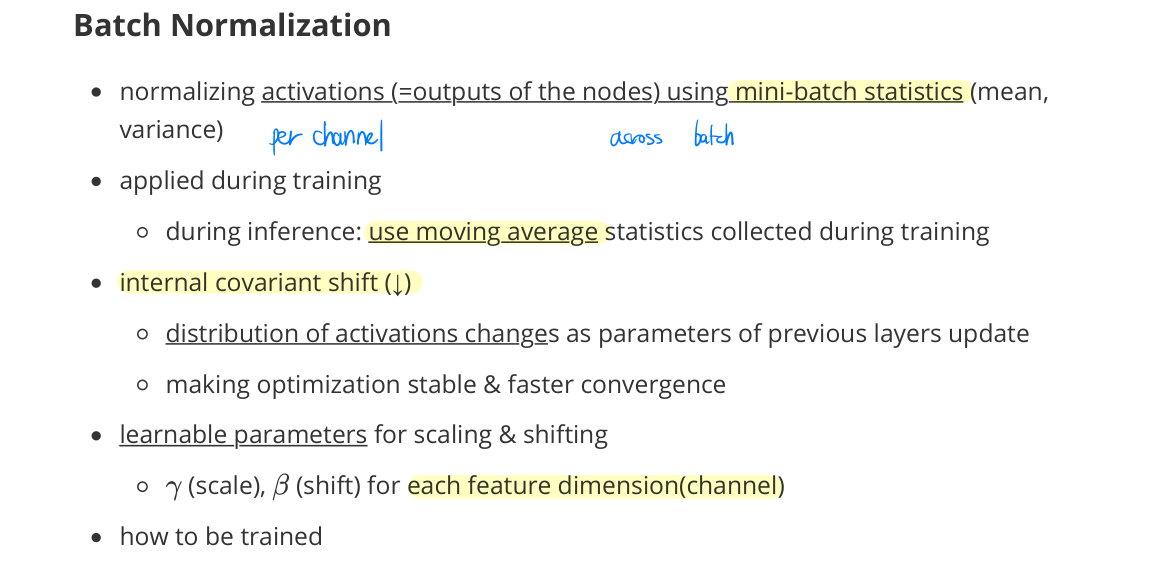
- normalizing activations (outputs of the nodes) using mini-batch statistics (mean, variance)
- applied during training
- inference: use moving-average statistics collected during training
- internal covariate shift (↓)
- distribution of activations changes as parameters of previous layers update
- making optimization stable and faster convergence
- learnable parameters for scaling and shifting
- $\gamma$ (scale), $\beta$ (shift) per feature dimension (channel)
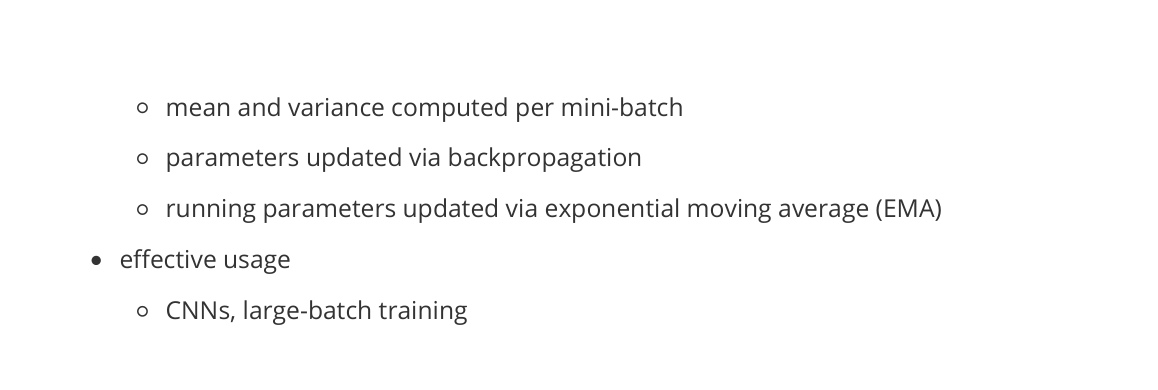
- training mechanics
- statistics computed per channel, across batch and spatial dims
- parameters updated via backpropagation
- running statistics updated via exponential moving average (EMA)
- usage
- CNNs, large-batch training
Layer Normalization
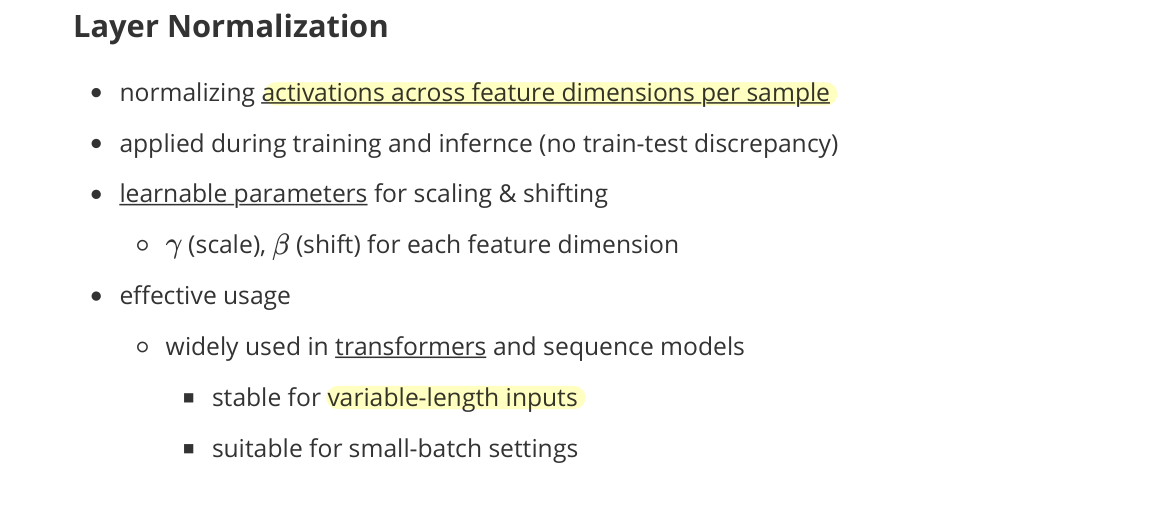
- normalizing activations across feature dimensions, per sample
- applied during training and inference (no train/test discrepancy)
- learnable parameters for scaling and shifting
- $\gamma$ (scale), $\beta$ (shift) per feature dimension
- effective usage
- widely used in transformers and sequence models
- stable for variable-length inputs
- suitable for small-batch settings
- widely used in transformers and sequence models
Instance Normalization
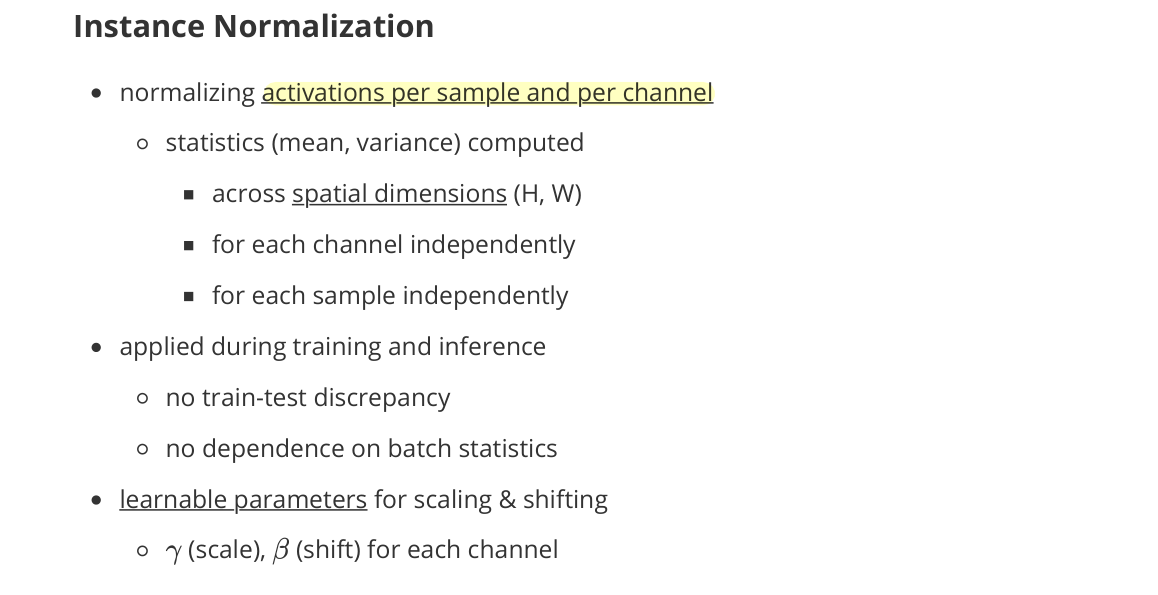
- normalizing activations per sample and per channel
- statistics (mean, variance) computed
- across spatial dimensions $(H, W)$
- for each channel independently
- for each sample independently
- statistics (mean, variance) computed
- applied during training and inference
- no train-test discrepancy
- no dependence on batch statistics
- learnable parameters for scaling and shifting
- $\gamma$ (scale), $\beta$ (shift) for each channel
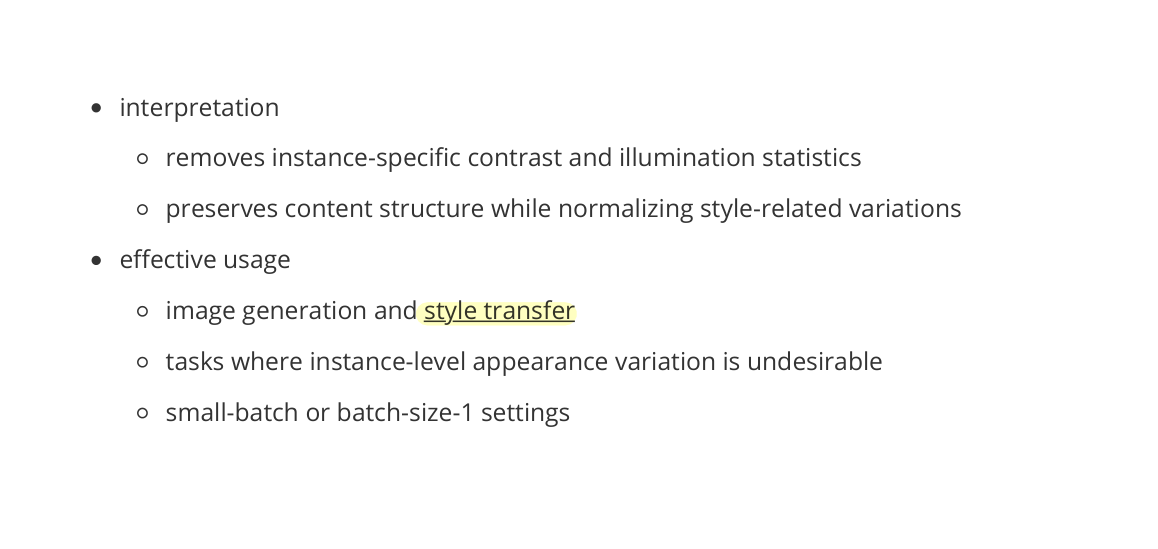
- interpretation
- removes instance-specific contrast and illumination statistics
- preserves content structure while normalizing style-related variations
- usage
- image generation and style transfer
- tasks where instance-level appearance variation is undesirable
- small-batch or batch-size-1 settings
Adaptive Instance Normalization (AdaIN)
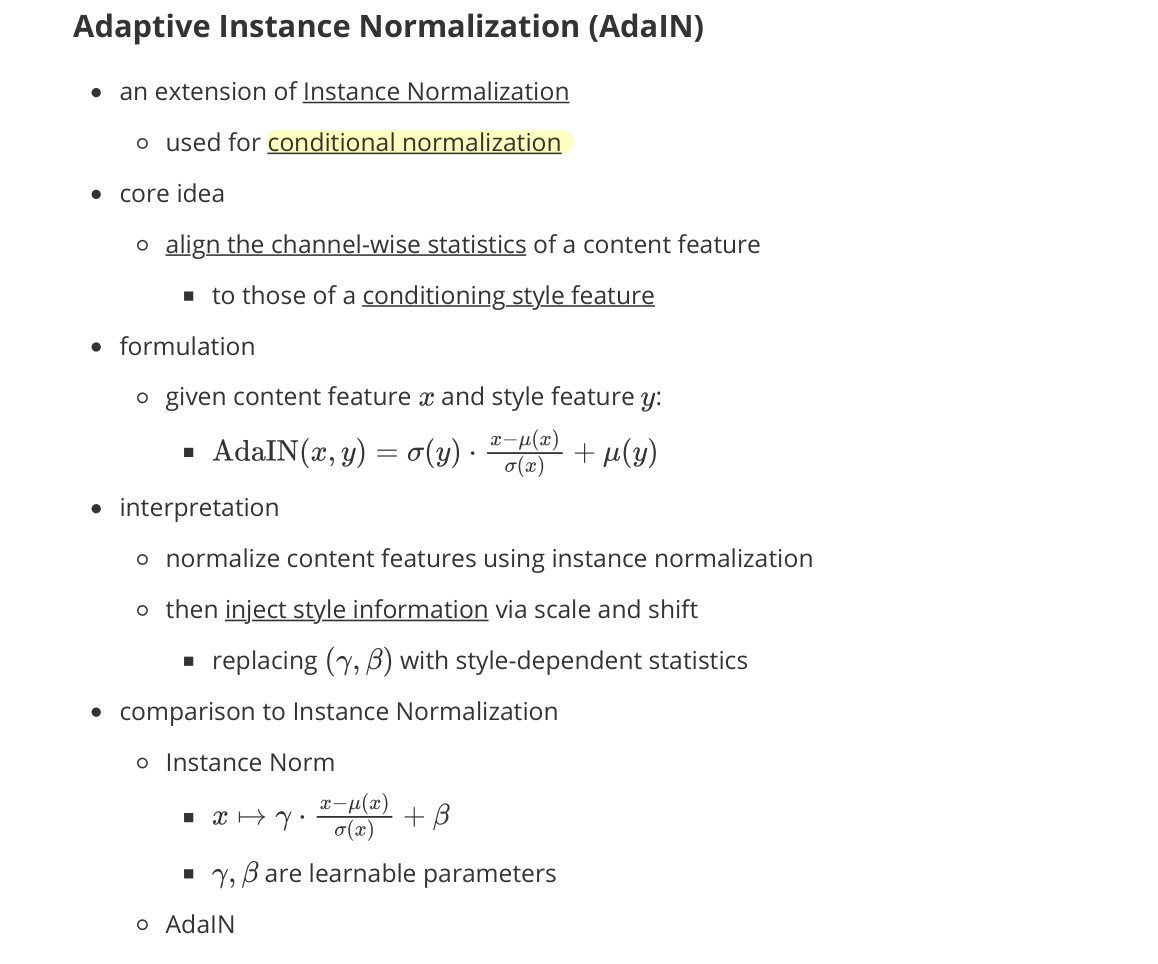
- an extension of Instance Normalization
- used for conditional normalization
- core idea
- align the channel-wise statistics of a content feature
- to those of a conditioning style feature
- align the channel-wise statistics of a content feature
- formulation
- given content feature $x$ and style feature $y$:
- $\text{AdaIN}(x, y) = \sigma(y) \cdot \dfrac{x - \mu(x)}{\sigma(x)} + \mu(y)$
- given content feature $x$ and style feature $y$:
- interpretation
- normalize content features using Instance Normalization
- then inject style information via scale and shift
- replacing $\gamma, \beta$ with style-dependent statistics
- comparison to Instance Normalization
- Instance Norm
- $x \mapsto \gamma \cdot \dfrac{x - \mu(x)}{\sigma(x)} + \beta$
- $\gamma, \beta$ are learnable parameters
- AdaIN
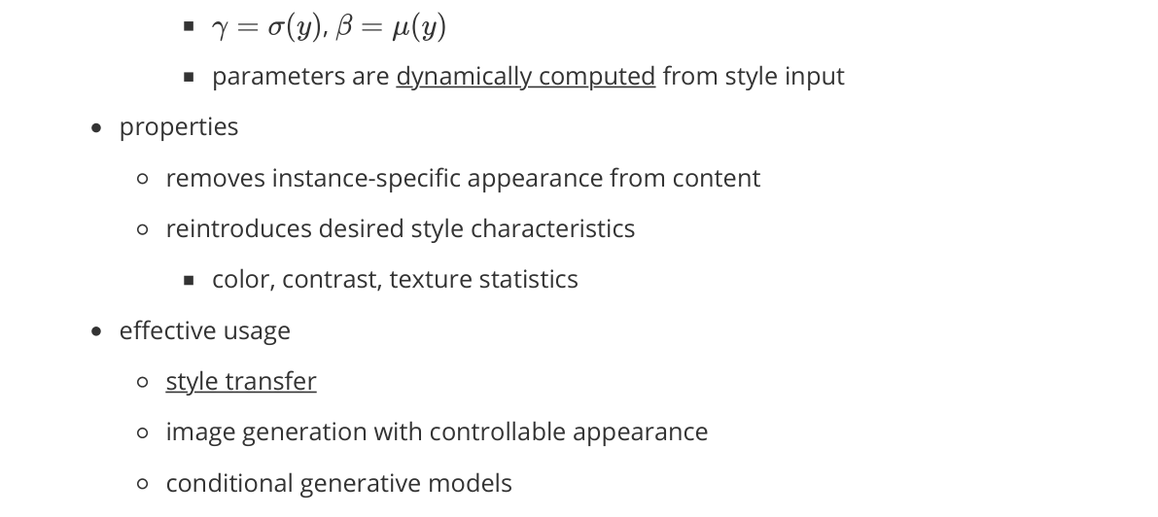
- $\gamma = \sigma(y), \beta = \mu(y)$ come from the style feature at runtime
- parameters are dynamically computed from style input
- Instance Norm
- properties
- removes instance-specific appearance from content
- reintroduces desired style characteristics
- color, contrast, texture statistics
- effective usage
- style transfer
- image generation with controllable appearance
- conditional generative models
Dropout
- randomly deactivate neurons during training
- prevent the network from relying too heavily on specific activations → overfitting ↓