- These notes were prepared while studying for technical interviews (e.g., Snap Inc., KRAFTON, etc.).
- Each entry contains a concise English summary, key math expressions, and excerpts from my original handwritten/typed study notes.
These notes cover the probabilistic foundations of ML: how to model uncertainty, update beliefs from data, and choose between maximum-likelihood and Bayesian objectives.
Bayes Theorem
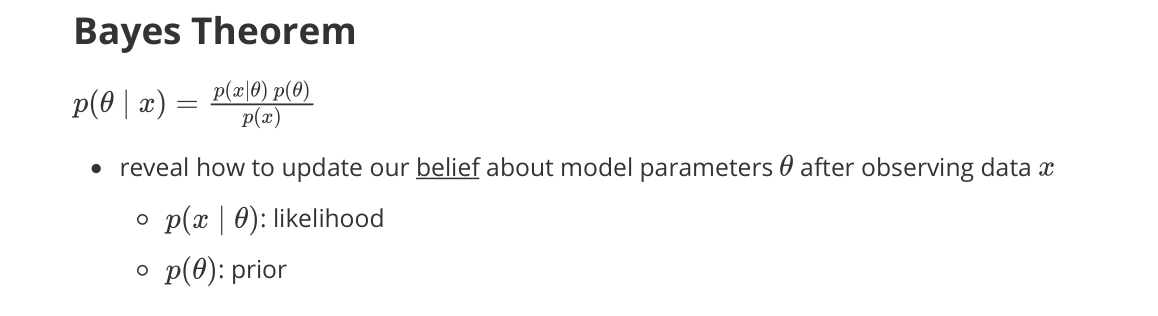
- reveals how to update our belief about model parameters $\theta$ after observing data $x$
- $p(x \mid \theta)$: likelihood
- $p(\theta)$: prior
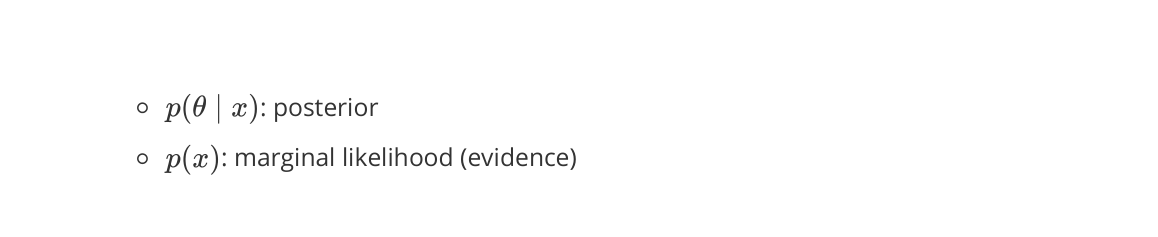
- $p(\theta \mid x)$: posterior
- $p(x)$: marginal likelihood (evidence)
Likelihood
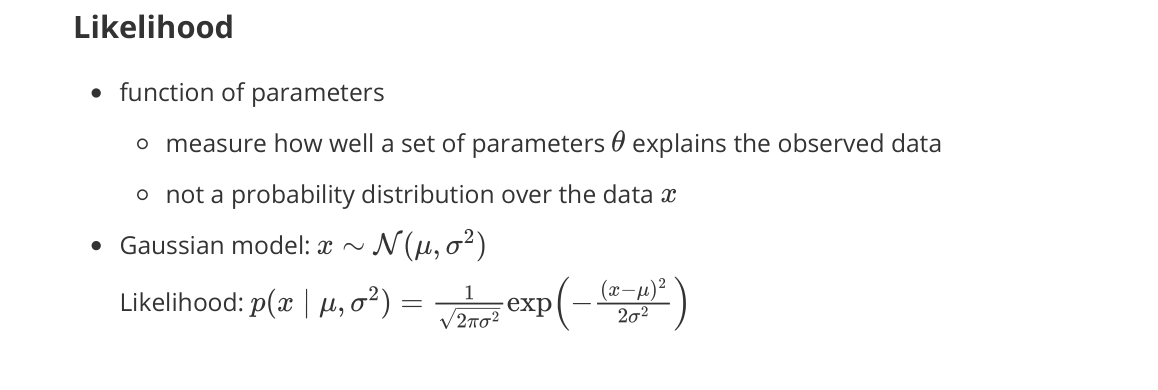
- a function of parameters
- measures how well a set of parameters $\theta$ explains the observed data
- not a probability distribution over the data $x$
- Gaussian model: $x \sim \mathcal{N}(\mu, \sigma^2)$
- likelihood: $p(x \mid \mu, \sigma^2) = \dfrac{1}{\sqrt{2\pi\sigma^2}}\, e^{-(x - \mu)^2 / (2\sigma^2)}$
Maximum Likelihood Estimation (MLE)
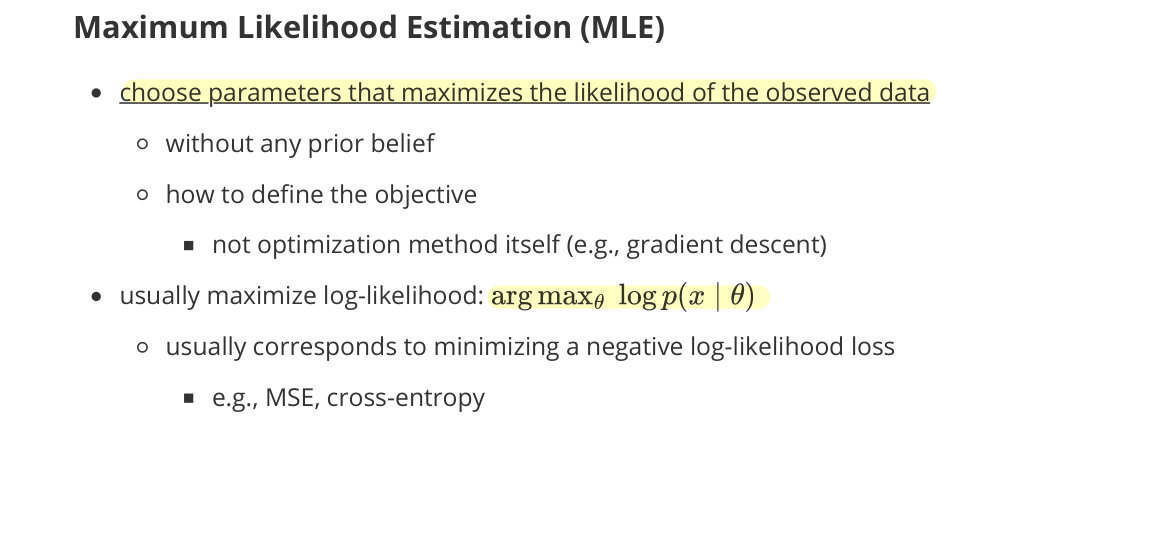
- choose parameters that maximize the likelihood of the observed data
- without any prior belief
- how to define the objective
- not an optimization method itself (e.g., gradient descent)
- usually maximize log-likelihood: $\arg\max_\theta \log p(x \mid \theta)$
- usually corresponds to minimizing a negative log-likelihood loss
- e.g., MSE, cross-entropy
- usually corresponds to minimizing a negative log-likelihood loss
Maximum A Posteriori (MAP)
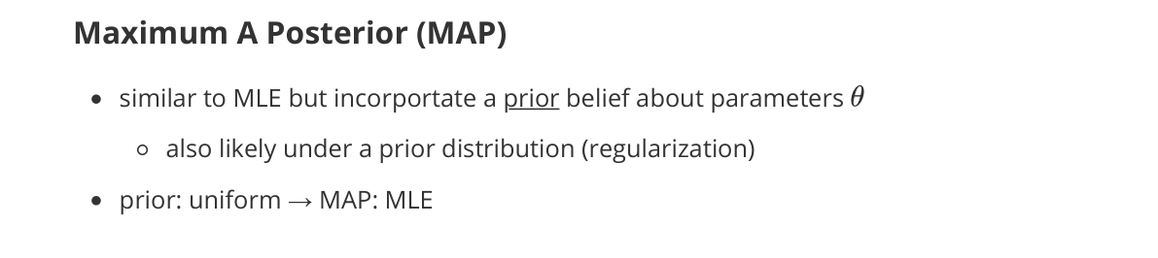
- similar to MLE but incorporates a prior belief about parameters $\theta$
- also likely under a prior distribution (regularization)
- if prior is uniform → MAP reduces to MLE
Probability Distributions
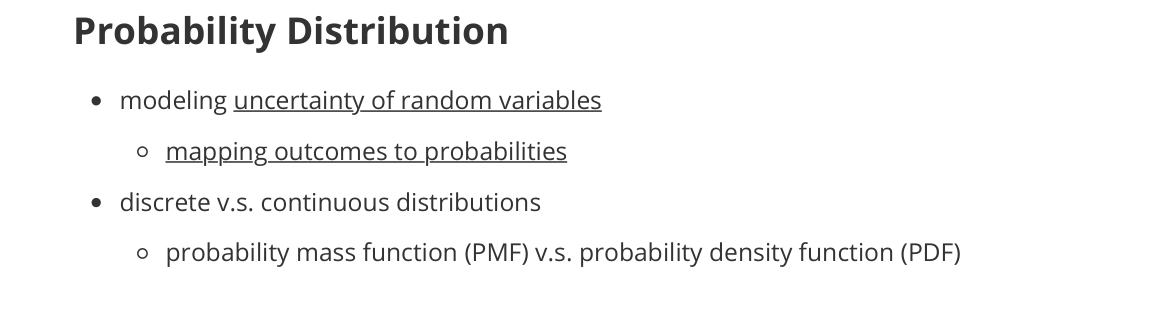
- modeling uncertainty of random variables
- mapping outcomes to probabilities
- discrete vs continuous distributions
- PMF (probability mass function) vs PDF (probability density function)
Bernoulli
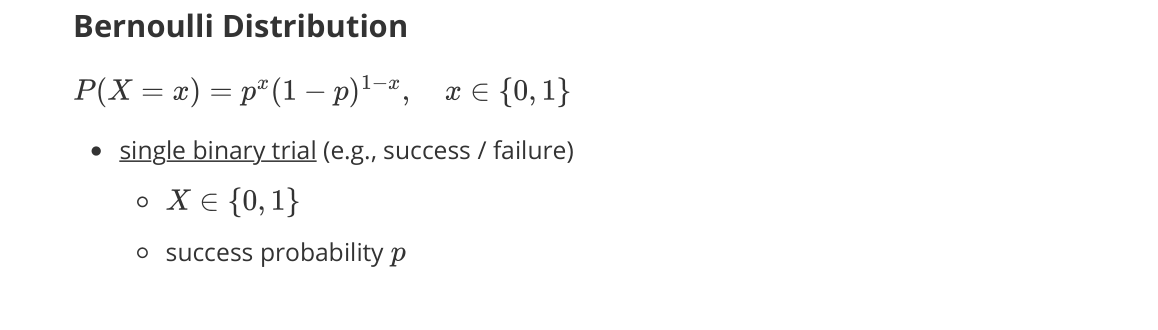
- single binary trial (e.g., success / failure)
- $X \in {0, 1}$
- success probability $p$
Binomial
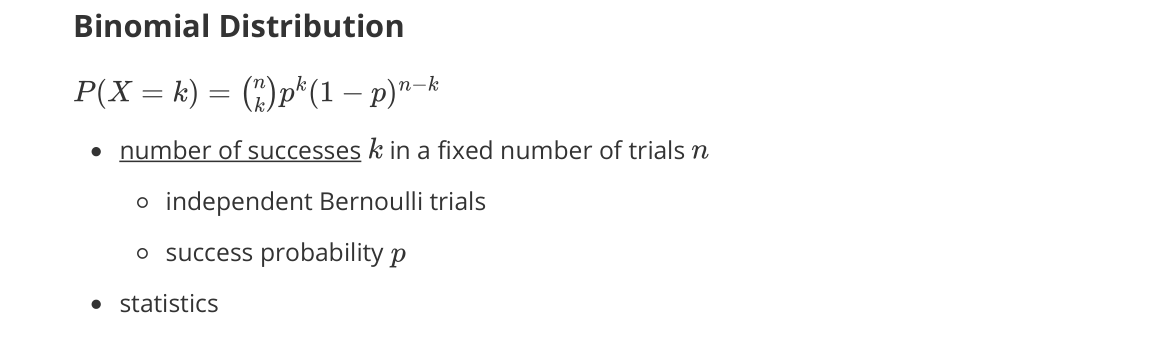

- number of successes $k$ in a fixed number of trials $n$
- independent Bernoulli trials
- success probability $p$
- Statistics
- mean: $np$
- variance: $np(1-p)$
- normal approximation when $n$ large
Multinomial
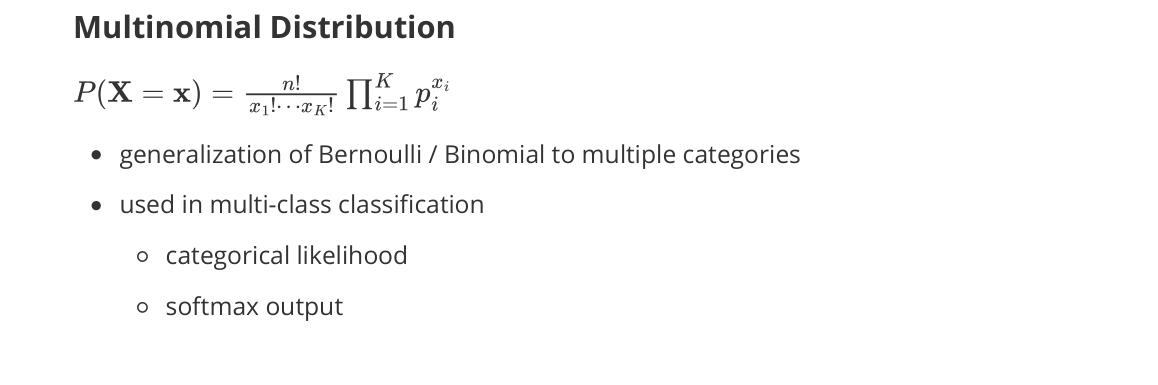
- generalization of Bernoulli / Binomial to multiple categories
- used in multi-class classification
- categorical likelihood
- softmax output
Normal (Gaussian)
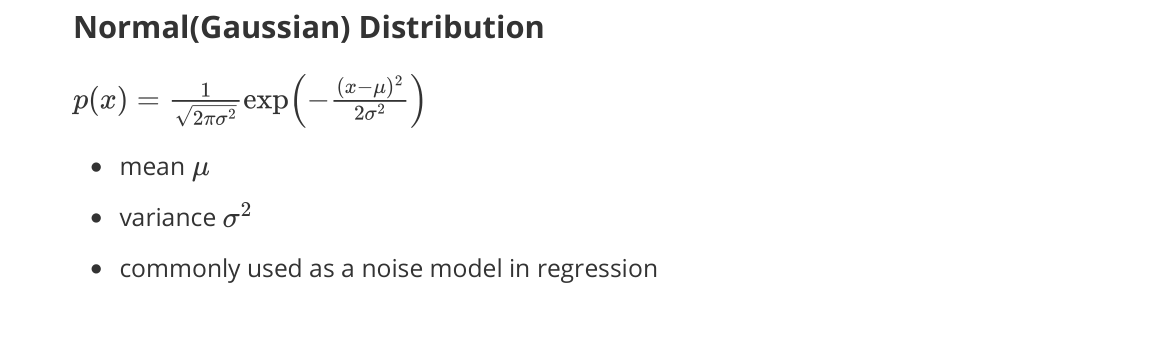
- mean $\mu$, variance $\sigma^2$
- commonly used as a noise model in regression
Exponential
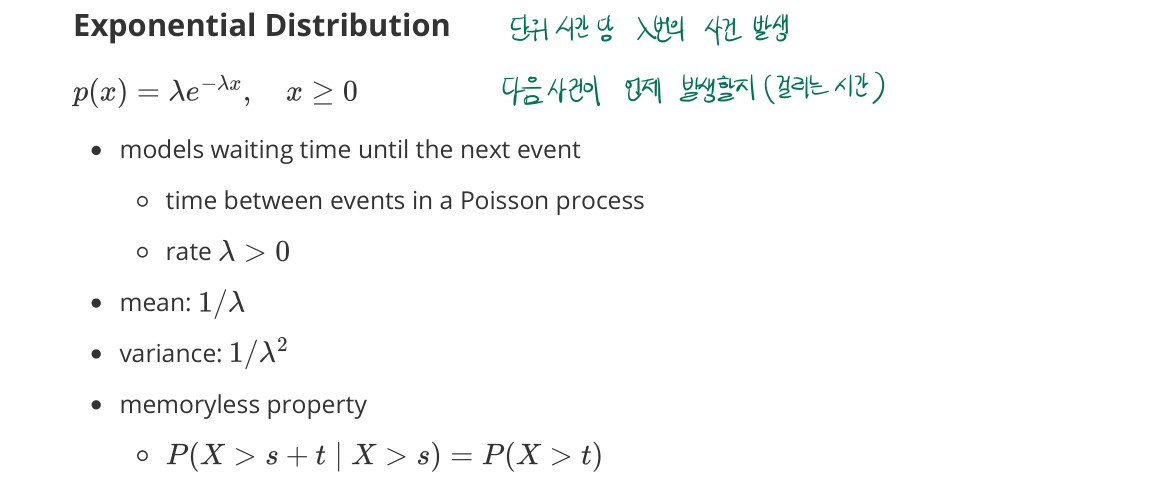

- models waiting time until the next event
- time between events in a Poisson process
- rate $\lambda > 0$
- mean: $1/\lambda$
- variance: $1/\lambda^2$
- memoryless property
- $P(X > s + t \mid X > s) = P(X > t)$
- future waiting time independent of the past
Poisson
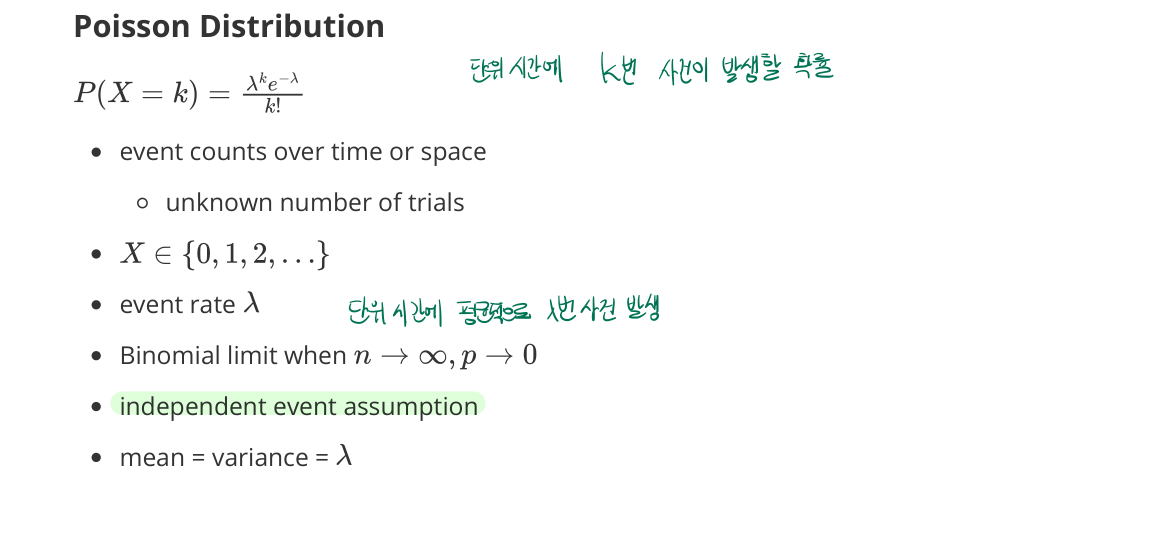
- event counts over time or space
- unknown number of trials
- $X \in {0, 1, 2, \ldots}$
- event rate $\lambda$
- Binomial limit when $n \to \infty,\, np = \lambda$
- independent event assumption
- mean = variance = $\lambda$
Gamma
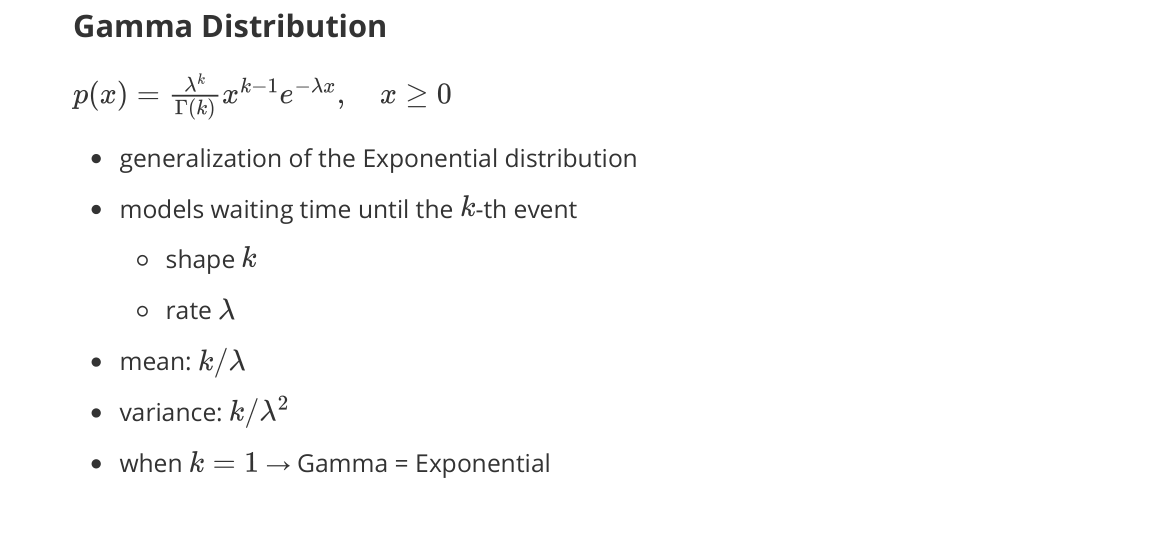
- generalization of the Exponential distribution
- models waiting time until the $k$-th event
- shape $k$
- rate $\lambda$
- mean: $k / \lambda$
- variance: $k / \lambda^2$
- when $k = 1$ → Gamma = Exponential
Central Limit Theorem (CLT)

- as the number of samples $n$ increases
- the distribution of the sample mean (after normalization) converges to a Gaussian distribution