- These notes were prepared while studying for technical interviews (e.g., Snap Inc., KRAFTON, etc.).
- Each entry contains a concise English summary, key math expressions, and excerpts from my original handwritten/typed study notes.
These notes cover two foundational regression models (the linear case for continuous targets and the logistic case for binary classification) and the probabilistic perspectives that connect them to MLE and MAP.
Linear Regression
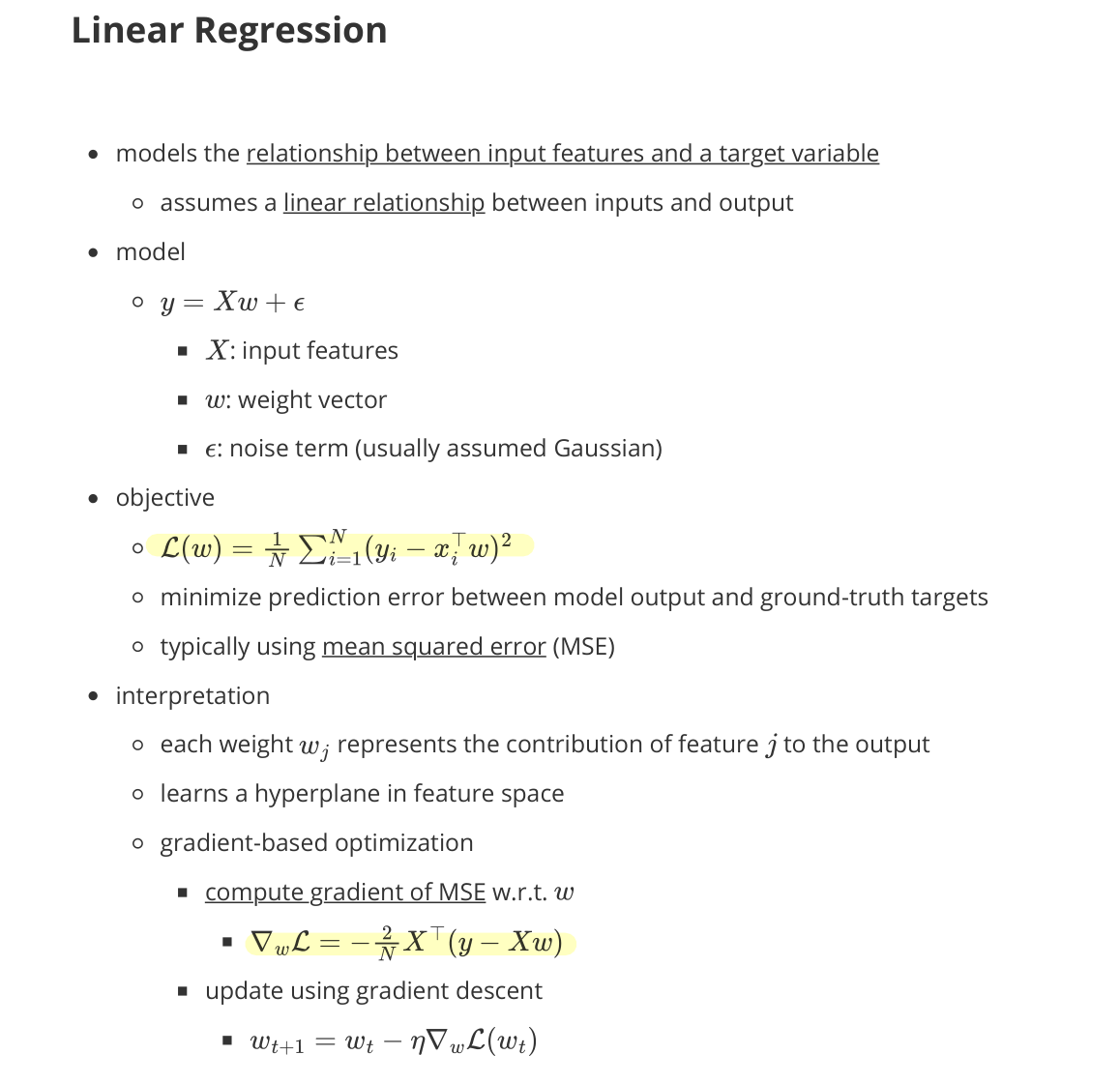
- models the relationship between input features and a target variable
- assumes a linear relationship between inputs and output
Model
\[y = w^\top x + \epsilon, \quad \epsilon \sim \mathcal{N}(0, \sigma^2)\]- $x$: input features
- $w$: weight vector
- $\epsilon$: noise term (usually assumed Gaussian)
Objective
- minimize prediction error between model output and ground-truth targets
- typically using mean squared error (MSE)
Interpretation
- each weight $w_j$ represents the contribution of feature $x_j$ to the output
- learns a hyperplane in feature space
Gradient-based optimization
- compute gradient of MSE w.r.t. $w$
- $\nabla_w \mathcal{L} = -\frac{2}{N} X^\top (y - Xw)$
- update using gradient descent
- $w_{t+1} = w_t - \eta\, \nabla_w \mathcal{L}(w_t)$
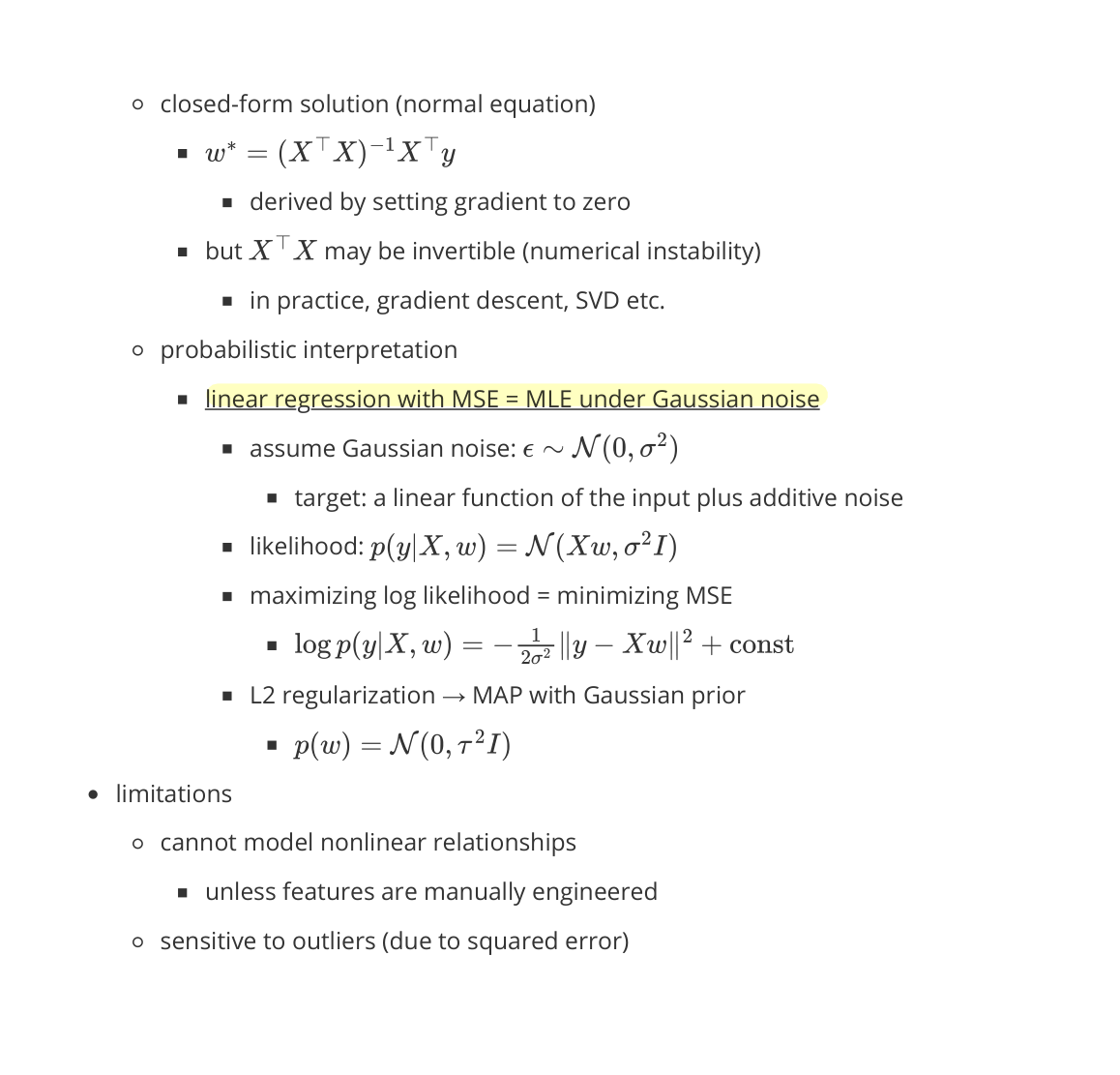
Closed-form solution (normal equation)
- $w^* = (X^\top X)^{-1} X^\top y$
- derived by setting gradient to zero
- but $X^\top X$ may be non-invertible (numerical instability)
- in practice: gradient descent, SVD, etc.
Probabilistic interpretation
- linear regression with MSE = MLE under Gaussian noise
- assume Gaussian noise: $\epsilon \sim \mathcal{N}(0, \sigma^2)$
- target: a linear function of the input plus additive noise
- likelihood: $p(y \mid X, w) = \mathcal{N}(Xw, \sigma^2 I)$
- maximizing log-likelihood = minimizing MSE
- $\log p(y \mid X, w) = -\frac{1}{2\sigma^2} |y - Xw|^2 + \text{const}$
- L2 regularization → MAP with Gaussian prior
- $p(w) = \mathcal{N}(0, \tau^2 I)$
- assume Gaussian noise: $\epsilon \sim \mathcal{N}(0, \sigma^2)$
Limitations
- cannot model nonlinear relationships
- unless features are manually engineered
- sensitive to outliers (due to squared error)
Logistic Regression
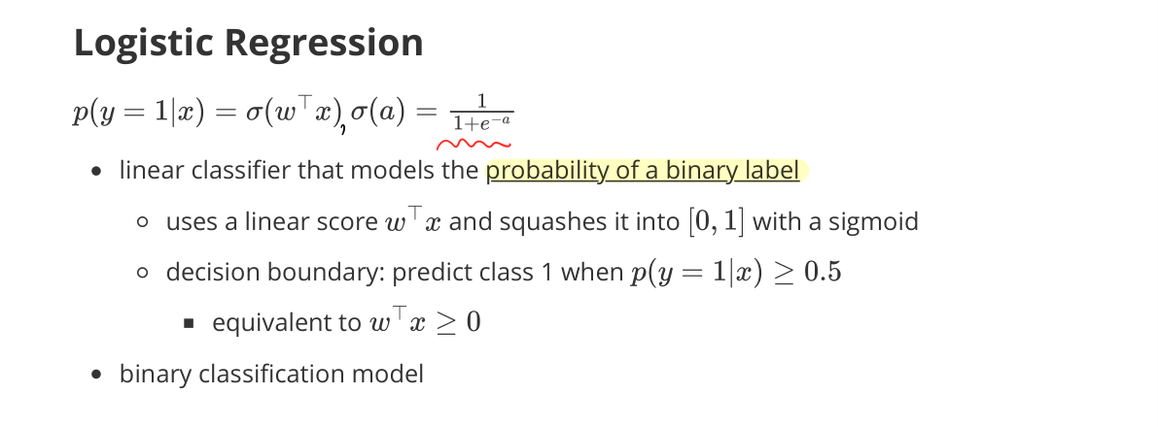
- linear classifier that models the probability of a binary label
- uses a linear score $w^\top x$ and squashes it into $[0, 1]$ with a sigmoid
- decision boundary: predict class 1 when $\sigma(w^\top x) > 0.5$, equivalent to $w^\top x > 0$
Model
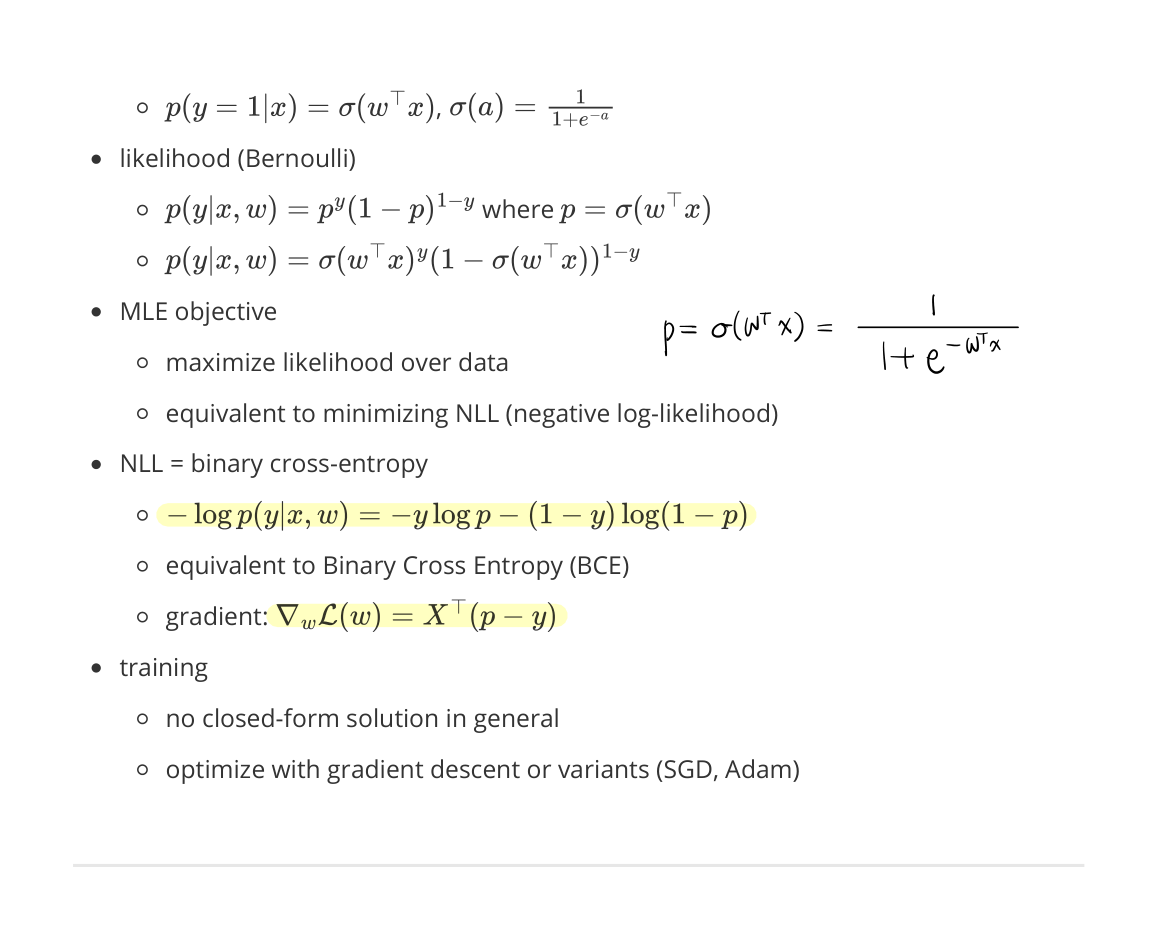
\[p(y = 1 \mid x; w) = \sigma(w^\top x) = \frac{1}{1 + e^{-w^\top x}}\]Likelihood (Bernoulli)
- $p(y \mid x, w) = p^y (1-p)^{1-y}$ where $p = \sigma(w^\top x)$
- $p(y \mid x, w) = \sigma(w^\top x)^y \, (1 - \sigma(w^\top x))^{1-y}$
MLE Objective
- maximize likelihood over data
- equivalent to minimizing NLL (negative log-likelihood)
NLL = Binary Cross-Entropy (BCE)
- $-\log p(y \mid x, w) = -y \log p - (1-y) \log (1 - p)$
- equivalent to Binary Cross-Entropy (BCE)
- gradient: $\nabla_w \mathcal{L}(w) = X^\top (p - y)$
Training
- no closed-form solution in general
- optimize with gradient descent or variants (SGD, Adam)