- These notes were prepared while studying for technical interviews (e.g., Snap Inc., KRAFTON, etc.).
- Each entry contains a concise English summary, key math expressions, and excerpts from my original handwritten/typed study notes.
These notes cover the theoretical conditions that make optimization problems tractable: when local solutions are global (convexity), what smoothness lets us bound step sizes, and how constrained problems are reformulated via duality.
Convexity
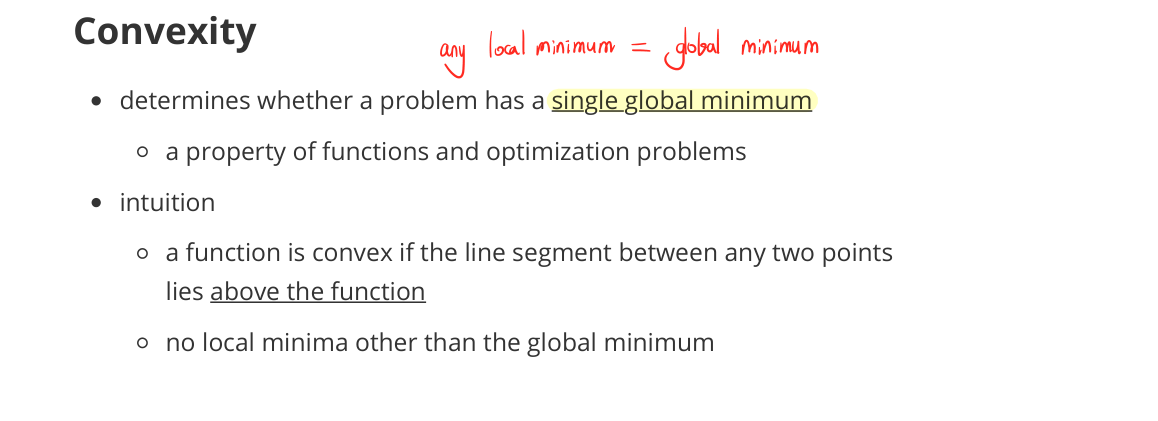
- determines whether a problem has a single global minimum
- a property of functions and optimization problems
Intuition
- a function is convex if the line segment between any two points lies above the function
- no local minima other than the global minimum
Convex Function
-
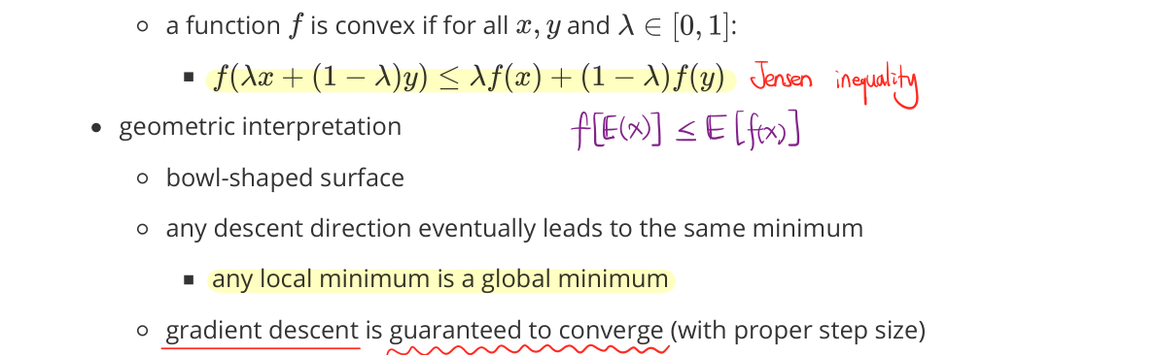
a function $f$ is convex if for all $x, y$ and $\lambda \in [0, 1]$:
\[f(\lambda x + (1-\lambda) y) \leq \lambda f(x) + (1-\lambda) f(y)\]- this is Jensen’s inequality in its discrete two-point form
- more generally: $f(\mathbb{E}[X]) \leq \mathbb{E}[f(X)]$ for any random variable $X$
-
geometric interpretation
- bowl-shaped surface
- any descent direction eventually leads to the same minimum
- any local minimum is a global minimum
- gradient descent is guaranteed to converge (with proper step size)
Hessian-Based Characterization
- for twice-differentiable functions
- $f$ is convex if its Hessian is positive semi-definite
- $H \succeq 0$ → convex
- $f$ is convex if its Hessian is positive semi-definite
- intuition
- eigenvalues of the Hessian represent curvature
- all eigenvalues $\geq 0$ → no direction curves downward
- example
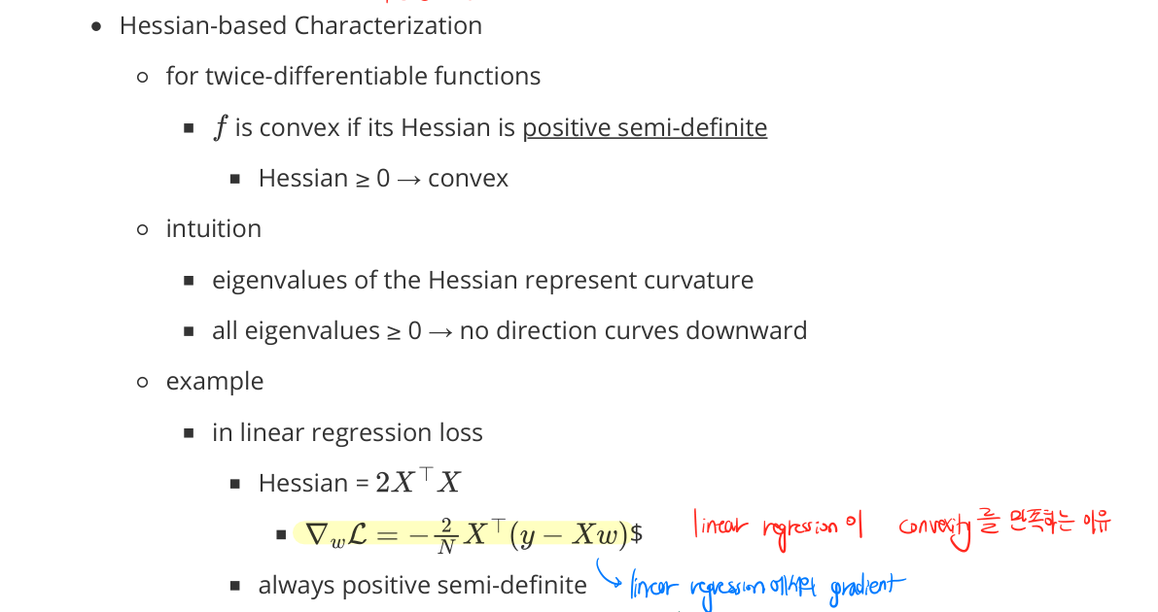
- in linear regression loss
- Hessian $= 2 X^\top X$
- $\nabla_w \mathcal{L} = -\frac{2}{N} X^\top (y - Xw)$
- always positive semi-definite
- in linear regression loss
Why Convexity Matters in ML
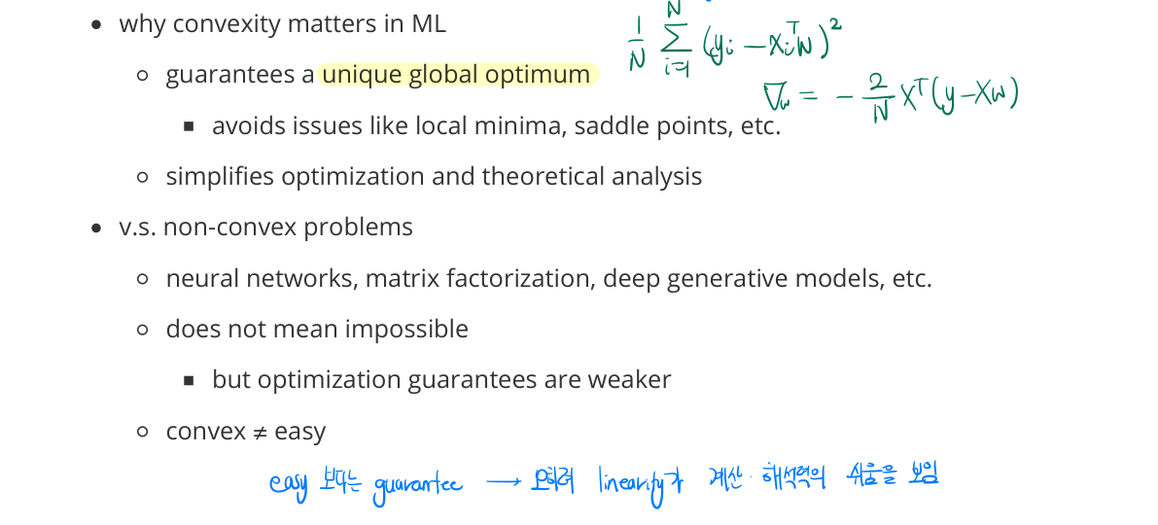
- guarantees a unique global optimum
- avoids issues like local minima, saddle points, etc.
- simplifies optimization and theoretical analysis
v.s. non-convex problems
- neural networks, matrix factorization, deep generative models, etc.
- does not mean impossible
- but optimization guarantees are weaker
- convex ≠ easy: large-scale convex problems can still be expensive
Lipschitz Continuity
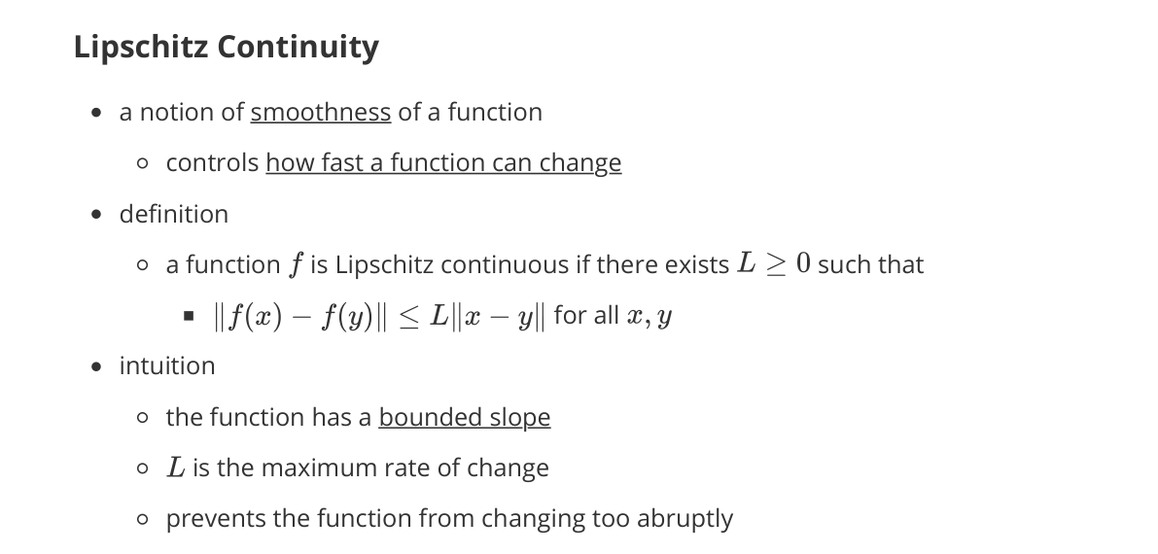
- a notion of smoothness of a function
- controls how fast a function can change
Definition
- $f$ is Lipschitz continuous if there exists $L \geq 0$ such that
Intuition
- the function has a bounded slope
- $L$ is the maximum rate of change
- prevents the function from changing too abruptly
Lipschitz Continuous Gradient (Smoothness)
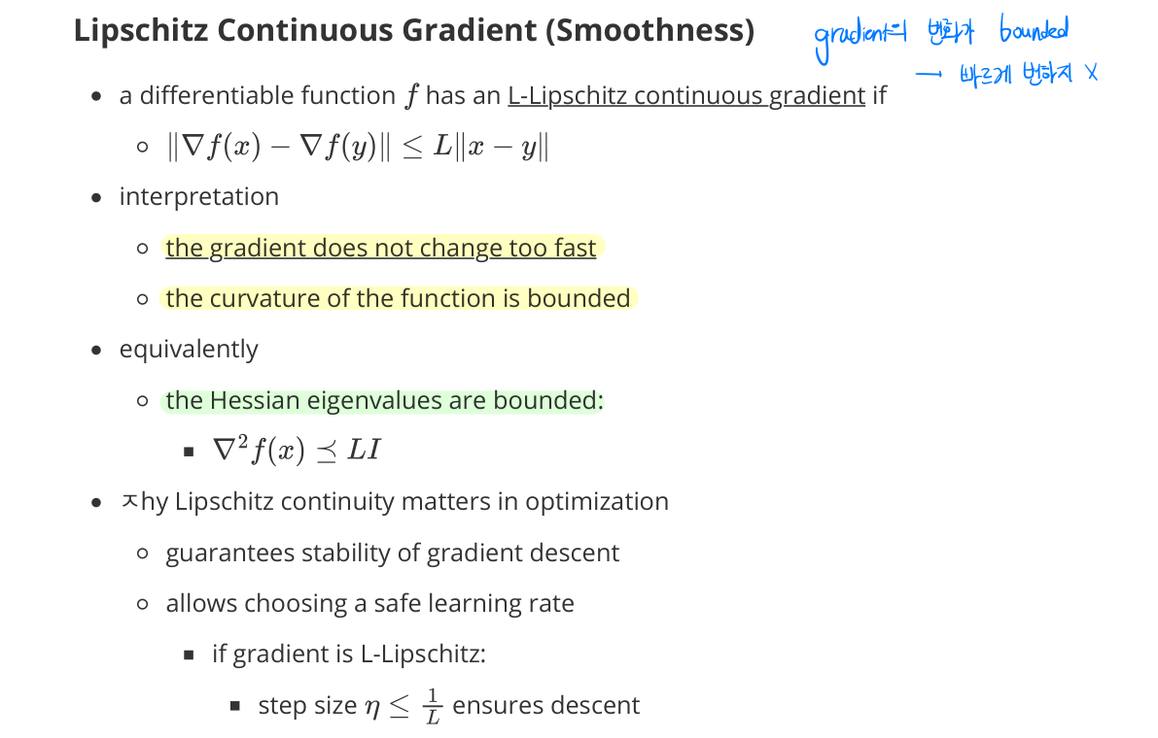
- a differentiable function $f$ has an $L$-Lipschitz continuous gradient if
Interpretation
- the gradient does not change too fast
- the curvature of the function is bounded
- equivalently, the Hessian is bounded above in Loewner order: $\nabla^2 f(x) \preceq L I$
Why Lipschitz continuity matters in optimization
- guarantees stability of gradient descent
- allows choosing a safe learning rate
- if gradient is $L$-Lipschitz: step size $\eta \leq \frac{1}{L}$ ensures descent
- provides convergence guarantees for first-order methods
Lagrangian Duality
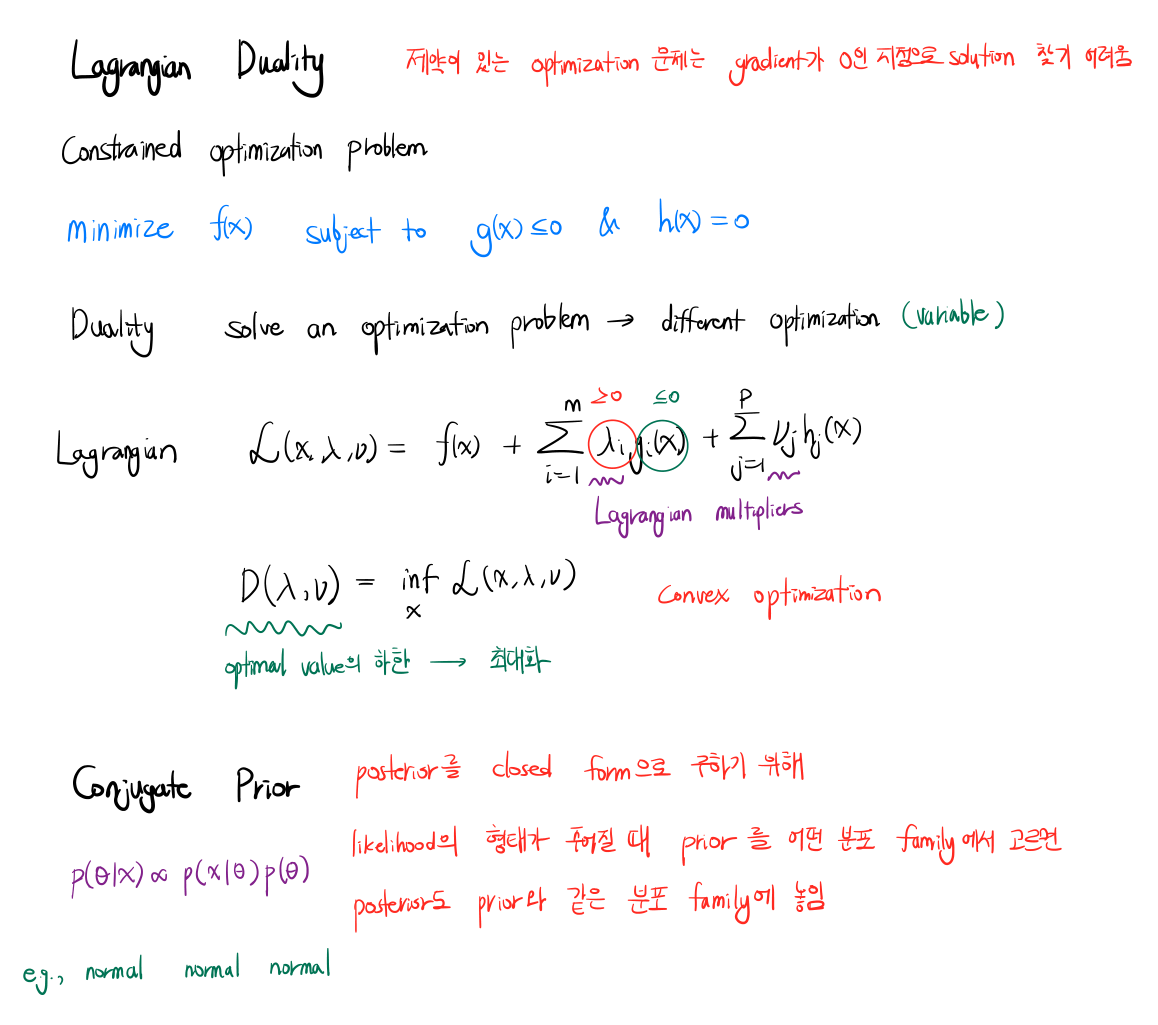
- constrained optimization problems are hard to solve directly with first-order methods (gradient zero is not enough when constraints are active)
- duality reformulates a problem in different variables, often easier to optimize
Constrained optimization problem
\[\min_x f(x) \quad \text{s.t.} \quad g(x) \leq 0, \quad h(x) = 0\]Lagrangian
\[\mathcal{L}(x, \lambda, \nu) = f(x) + \sum_i \lambda_i g_i(x) + \sum_j \nu_j h_j(x), \quad \lambda_i \geq 0\]- $\lambda, \nu$ are Lagrangian multipliers
Dual function
\[D(\lambda, \nu) = \inf_x \mathcal{L}(x, \lambda, \nu)\]- lower bound on the optimal value of the primal problem
- the dual problem maximizes $D$ subject to $\lambda \geq 0$
Conjugate Prior (Bayesian context)
- to obtain a posterior in closed form given a likelihood family
- choose a prior family such that the posterior stays in the same family
- $p(\theta \mid x) \propto p(x \mid \theta) p(\theta)$
- e.g., Gaussian-Gaussian-Gaussian conjugacy